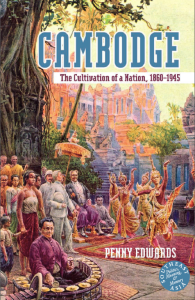
BOOK REVIEW Penny Edwards’ Cambodge: The Cultivation of a Nation 1860-1945 (2007)


Screen Shot 2016-04-03 at 10.35.18 AM

Edwards, Penny. Cambodge: The Cultivation of a Nation 1860-1945. University of Hawaii Press, 2007.

In the seminal work Cambodge, Penelope Edwards offers a complex genealogy of the modern nation, Khmer-ness, and the ‘Original Khmer’ (Kmae daem). Edwards demonstrates how cultural and national identity were interwoven with the construction of Angkorean antiquity throughout the French colonial period in Cambodia (1863-1954). Pushing against arguments of colonial hegemony as well as the elision of the colonial period from contemporary nationalism, Edwards argues that the development of an Angkor narrative was never monolithic. Instead, diverse groups of colonial administrators, European savants, Khmer elite intellectuals, and Buddhist reformers and leaders contributed various visions of Khmer-ness, culture, history, and modernity.

Continue reading “BOOK REVIEW Penny Edwards’ Cambodge: The Cultivation of a Nation 1860-1945 (2007)”

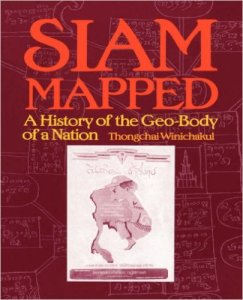
BOOK REVIEW Thongchai Winichakul’s Siam Mapped: A History of the Geo-Body of a Nation (1994)

51QKZO5Bn8L._SX403_BO1,204,203,200_

Thongchai Winichakul. Siam Mapped: A History of the Geo-Body of a Nation. Honolulu: University of Hawaii Press, 1994.

In Thongchai Winichakul’s innovative mongraph Siam Mapped, the discourse of geography and the modern map directly produce the political territoriality, values, practices, and geobody that would later become the modern Thai nation. Thongchai demonstrates how indigenous concepts of space are displaced by modern geographic and mapping science. At the same time, local and indigenous concepts of space should not be evaluated through Western understandings of ‘scientific merit’ but understood to serve different purposes (such as traiphum cosmology).

Continue reading “BOOK REVIEW Thongchai Winichakul’s Siam Mapped: A History of the Geo-Body of a Nation (1994)”

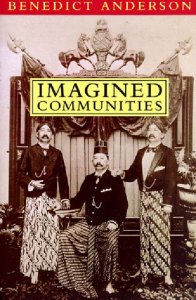
BOOK REVIEW Benedict Anderson’s Imagined Communities: Reflections on the Origin and Spread of Nationalism (1983, 1991, 2006)

andersonAnderson, Benedict R. O’G. Imagined Communities Reflections on the Origin and Spread of Nationalism. Rev. ed. London; New York: Verso, 2006.

In Imagined Communities, Benedict Anderson argues that the nation is a new, modern phenomenon. The 17th and 18th century witnessed the demise of previous forms political bodies that were shaped by a sacred language, sacred cosmology and dynastic power, and sense of historical temporality shaped by cosmology. Material conditions and rationalist perception of ‘homogenous empty time’ created the structures where individuals could conceptualize themselves as part of an ‘imagined community.’ The imagined community is one in which members will not know most of their fellow members, is finite with limited boundaries, sovereign power, and a community of fraternal, horizontal comradeship. It is through the emergence of print-capitalism—the technological, mass production of newspapers and the novel and the spread of vernacular print languages—that individuals could think of themselves and relate to others in different ways. This possibility to envision parallel and plural realities connected individuals to other individuals to form a concept of an ‘imagined community.’

Continue reading “BOOK REVIEW Benedict Anderson’s Imagined Communities: Reflections on the Origin and Spread of Nationalism (1983, 1991, 2006)”

Edward Said, Orientalism, and Caste: The Development of a Discourse and Field of Study

51k6n6ma-NL

Below is a working paper I wrote for Professor Janaki Bakhle’s class on Caste, Culture, Religion–The Anthro-History of South Asia. I review and examine Edward Said’s seminal work Orientalism and the development of studies on caste in South Asia.


Since its publication in 1978, Edward Said’s Orientalism has developed to be the leading canonical text for cultural studies, critical post-modern and post-colonial studies, and studies of the Middle East and Islam.[1] In Orientalism, Edward Said develops a two-part argument: Since the late sixteenth century European writers, scholars, and scientists produced an idea and ‘imaginative geography’ of the ‘Orient’ (the East) as strange, exotic, dangerous and putatively opposite to the civilizational superiority of the ‘Occident’ (the West). Over time, this discourse of the ‘orient’ manifested in institutions, imagery, scholarship, and colonial styles into the formal academic discipline of Orientalism with a set of epistemologies, rational justifications, and scientific explanations that perpetuate a binary between the West and the East. Said argues that since the late eighteenth century, there has been a steady interchange between the imaginative meanings of the Orient and the academic tradition of ‘orientalism’. Examining orientalism as a discourse, Said demonstrates how Europeans have managed, produced, and invented the Orient and the Occident.

This essay examines the historiography of Indian caste through the two-part argument in Said’s Orientalism. Examining scholarship on caste from early Portuguese missionary reports to studies of colonialism and caste, I will consider both how European scholars represent, imagine, and understand Indian caste and also how this body of Oriental knowledge informed colonial understandings of caste. This essay is divided into three parts. The first part examines Edward Said’s Orientalism, the core arguments and methods, and the lasting effects on post-colonial and cultural studies. The second and main part of this essay analyzes the historiographical trends in studies of caste in the early writing of Abbé Dubois, Louis Dumont, Émile Durkheim, and Max Weber. The concluding part considers the more contemporary writing on caste and colonialism by Bernard Cohn and Nicholas Dirks. I focus on the historiographical shift in studies of India marked by Nicholas Dirks’ Castes of Mind, which called into question the implications of British colonial epistemologies on scholarship of Indian caste. Through this historiography I seek to trace the contours, continuities, and ruptures within the discourse on Indian caste.

Continue reading “Edward Said, Orientalism, and Caste: The Development of a Discourse and Field of Study”

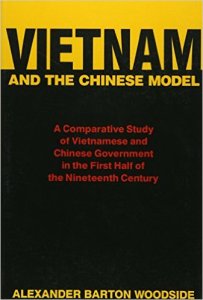
Q. How Confucian is/was Vietnam? Woodside, Kelley, and Cooke

41Ky6vzZr8L._SX335_BO1,204,203,200_
Woodside, Alexander. 1971. Vietnam and the Chinese Model: A Comparative Study of Vietnamese and Chinese Government in the First Half of the Nineteenth Century. Cambridge: Harvard University Press.
Alexander Woodside examines how Confucian institutions were adopted and adapted by 19th century Nguyen Vietnam. Woodside then catalogs and compares the institutions in Vietnam and China and documents the reasons why Vietnam does not exactly replicate Chinese and Confucian characteristics. The five chapters examine themes of acculturation, civil administration, court bureaucrats and provincial administration, and education and exams. Among the tremendous details of  bureaucratic, administrative, and educational comparisons between Vietnam and China, Woodside demonstrates how the local variants of Confucian systems in Vietnam. He concludes that these differences were due to the problem of scale and relative size of Vietnam to China (too many administrative units for too small a space), the cultural diversity and distance between bureaucrats and peasants, and the simplification and translation of Confucian bureaucracy as a coherent system. ( “VN regional differentiation 1)variety of environments, agriculture, and settlement 2)little cultural standardization at village level, varied village traditions 3) 16th-19th century N v. C S different political units 4) movement south and diff backgrounds” )Woodside characterizes these aspects into the abstract themes of 1) pattern saturation, 2) cultural parallelisms (such as dual monarchy of hoang de and vua), 3) environmental-institutional tensions, and 4) divergences in social structure and resources.

Continue reading “Q. How Confucian is/was Vietnam? Woodside, Kelley, and Cooke”

Questions & Debates in the History of Statistics, Counting, and Quantification

william-playfair-wheat-excel

A few questions on the history of statistics and quantification from my Qualifying Exams list on History of Knowledge Systems.

Examiner: Cathryn Carson

Second Field: History of Knowledge Systems

  1. History of Information, Enlightenment Institutions, ‘Information Ages’
  2. History of Information, Documentation, Catalogs, Libraries/Archives
  3. History of Statistics, Quantification, and Counting
  4. History of Data Science

Continue reading “Questions & Debates in the History of Statistics, Counting, and Quantification”

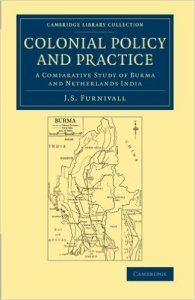
Book Review: J.S. Furnivall’s Colonial Policy and Practice

510rRD+vH8L._SX322_BO1,204,203,200_
 
Furnivall argues that British Burma was ruled by direct rule and Dutch East Indies was ruled by indirect rule. Direct rule generally consists of the removal of the local monarchy and legal court and replacement by foreign legal system. Indirect rule is characterized by the retention of local governing bodies and leaders while the top level administration and economic affairs are directed by foreign colonial officials. Although in reality these demarcations are more nuanced, Furnivall makes this distinction to support his overarching argument about the negative impact of colonial capitalism upon colonies’ economic and social welfare. In the case of British Burma, the undermining of local forms of governance such as the monarchy, the village, and Buddhist Sangha and unchecked Liberal capitalism resulted in the disintegration of society into a plural society. In other words, the British colonial government failed to preserve the social and village life of Burma in light of economic forces of capitalism more so than in the Dutch East Indies.

Continue reading “Book Review: J.S. Furnivall’s Colonial Policy and Practice”

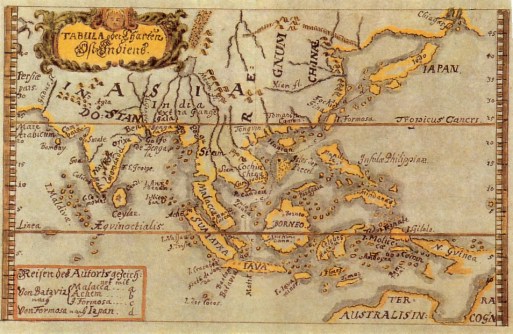
Annotated bibliography and the State of Southeast Asian Studies

CasparSchmalkalden_AsiaMap

Below is my annotated bibliography and key questions/themes for Part I of my list with Penelope Edwards on Southeast Asia. This part covered the state of the field of Southeast Asian studies.

  1. State of the field of Southeast Asian Studies
  2. Southeast Asia Colonialism and Modernity
  3. Southeast Asia Print Culture & History of the Book
  4. Southeast Asia Institutions: Museums & Libraries

  Continue reading “Annotated bibliography and the State of Southeast Asian Studies”

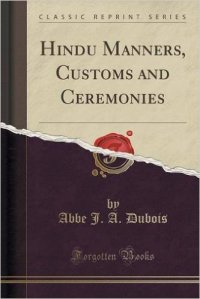
BOOK REVIEW: Abbe Dubois’ Hindu Manners, Customs and Ceremonies

41+N6kv3geL._SX331_BO1,204,203,200_

Dubois, J. A., and Henry K. Beauchamp. Hindu Manners, Customs and Ceremonies. 3d ed. Delhi: Oxford University Press, 1978.

Chapter V and pp. 160-367

Observation and Moral Comparisons

Continue reading “BOOK REVIEW: Abbe Dubois’ Hindu Manners, Customs and Ceremonies”