Honored to deliver this keynote with Global DH 2026–to be capacious and humble that centers the importance of why DH, now?
Abstract: How do we confront the ongoing epistemological violence of colonialism upon the cultural record? This talk seeks to confront this cultural record of colonialism that perpetuates an epistemological divide between the west and rest, modern and traditional, global north and south. I draw from an extended digital humanities case study of an early twentieth century French colonial visual encyclopedia of Vietnamese crafts, cultural practices, and technologies. In conversation with decolonial and feminist theory, Indigenous and Southeast Asian studies, I argue that a critical interpretive digital humanities can make visible the layers of colonial representation, surface plural voices and multidirectional narratives, and dwell in the discomforts of unknowability. This commitment seeks to challenge top down, linear, hegemonic colonial representations that often materialize in static forms of data representations, the privileging of Western frameworks of authorship, and a scientific push towards empirical argumentative findings. As a provocation on research praxis, this keynote confronts disciplinary global north structures of knowledge production and advocates for multivocality as research design principle. In community with her students, this talk moves towards a transparency of method and intention, inviting a critical digital humanities that is messy, incomplete, humble, and collective.
Concluding remarks excerpt: “And ultimately, as conclusion. I too am communicating my attempts and limitations of my keynote.
(I drafted this keynote, recognizing how radical, ‘decolonial’, ‘critical academic’, as Stefano Harney and Fred Moten have emphatically argued, carry out the state power of universities as professionalization economic systems.
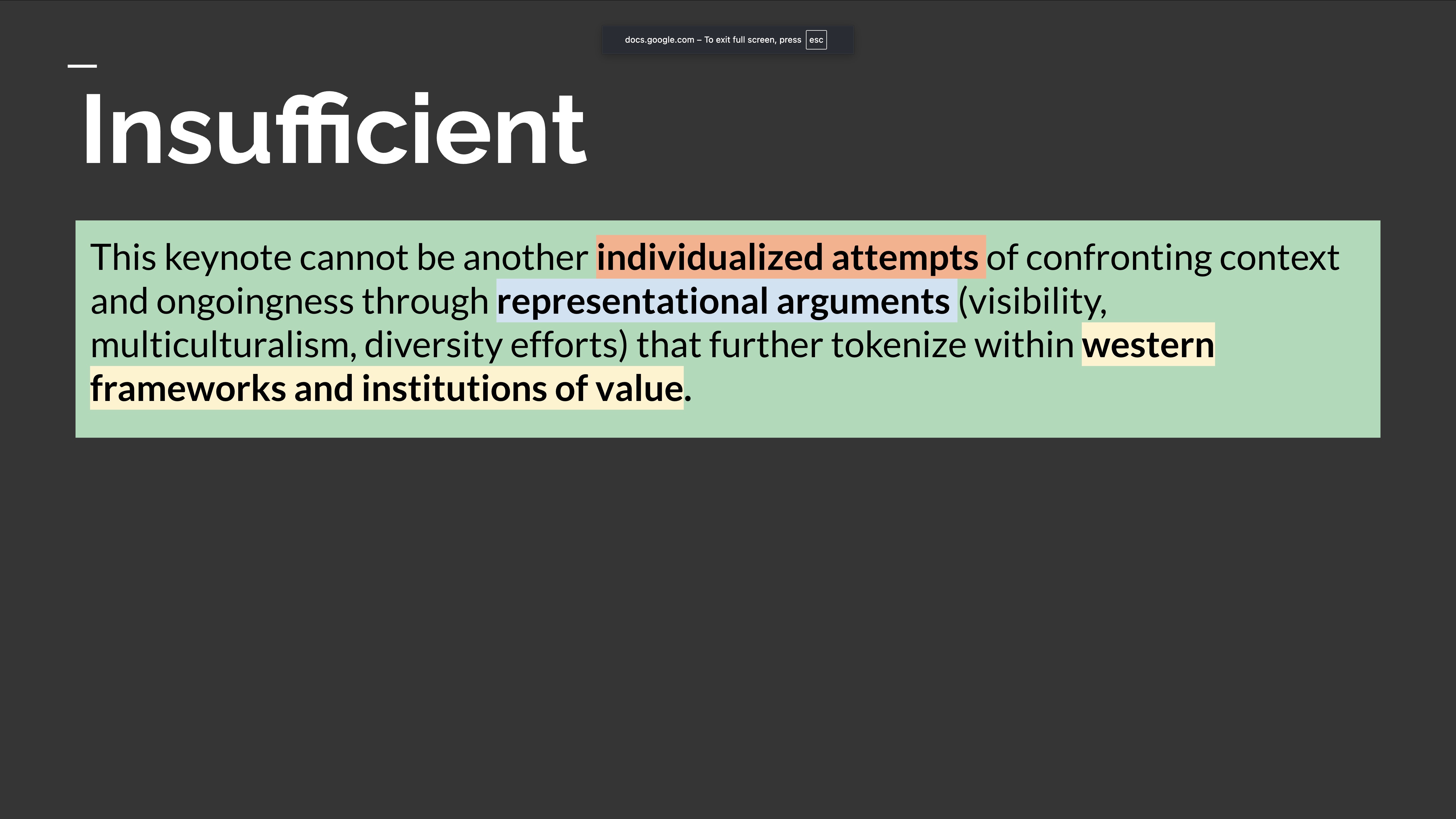
This keynote cannot yet be another individualized ‘scholar” keynote attempt to confront the context and ongoingness of colonialism…I cannot make more representational arguments about multiculturalism and diversity that ultimately tokenize within western frameworks and institutions of value.
Instead. My attempt here, is to show the collective coalition work I, we, all of us are involved in.
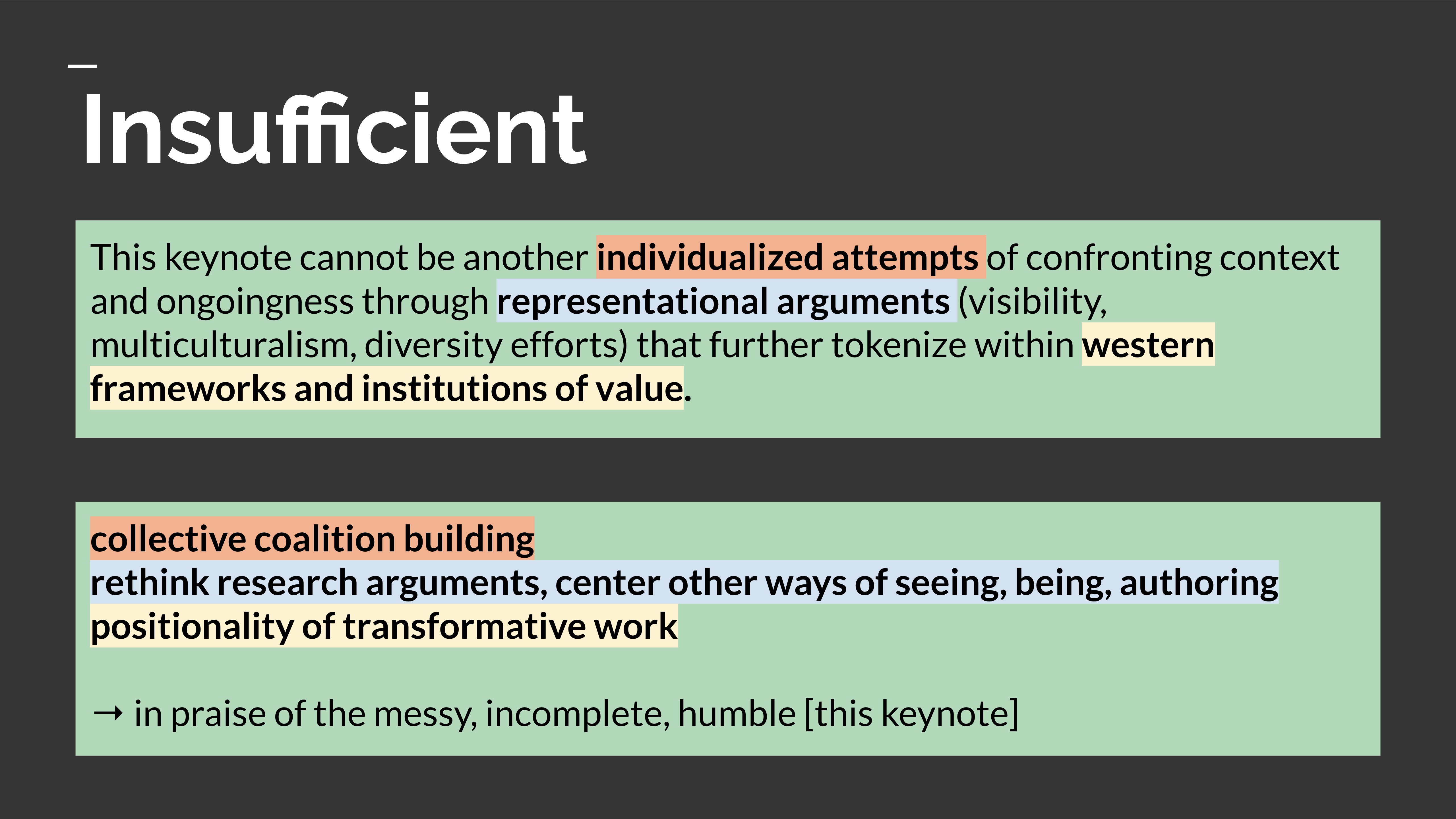
That we can challenge ‘research argument’ and center other ways of seeing-reading-interpreting–in our “DH imprints” in bringing the messy projects in to the classroom, through recursive multivocal interpretation
and lastly to recognize the locus of operations where I work, in a global north institution–how my transformative work shouldn’t be exported, but is social and relational based–in the classroom, the research project, working in the background undercommons-funding while grassroots community partners, in Southeast Asia carry out their work in arts advocacy, cultural heritage.
I come from at least three generations of those without formal lettered learning. Their education came from community, survival, the world. I say this for two reasons. First to recognize the life exists outside the university. Second if we are to operate within a university, to recognize the possibilities of a different type of research transparency that could happen through DH. 13 years ago at the beginning of my grad career. as a first generation newcomer to American higher education, I encountered historians, literary scholar, who carried a mystique of the solitary genius philosopher with high theories, an impossible memory for names and dates, and mic drop inspirational insight drawing from an obfuscated cryptic process of “close reading”.
At the same time, I encountered digital humanities which opened up a different type of scholarly world then and now: DH could be collaborative, team based, public facing, formed through community. methods could be communicated,experimental, playful, weird and wildly capacious. A dh Scholarship that must be accountable and honest as they exist in unequal systems, many of which are crumbling: through research design, structures of equitable and compassionate labor, scaling and slowing down in a world that asks us to produce more and accelerate. Through these messy, incomplete, humble, honest processes, dominant scholarly form and research significance could and must be continually challenged and reimagined.
Thank you.”

