BOOK REVIEW Peter Zinoman’s Vietnamese Colonial Republican: The Political Vision of Vũ Trọng Phụng (2013)

Screen Shot 2016-04-19 at 8.57.04 PM

Zinoman, Peter. Vietnamese Colonial Republican: The Political Vision of Vũ Trọng Phụng. University of California Press, 2013

Using never before translated writings, literary sources, and family archives, Peter Zinoman meticulously traces life and works of Vu Trong Phung (1912-1939), one of Vietnam’s most prolific and controversial modernist writers of the twentieth century. Through the intellectual history of Vu Trong Phung, Zinoman reveals the dynamics of intellectual life and publication in late colonial society as well as the cultural politics of post-colonial censorship through Phung’s enduring reputation. Zinoman argues that Phung was a ‘late colonial republican’—a term coined by Zinoman to characterize Phung’s inchoate combination of anti-communism, anti-capitalism, and anti-colonialism in his writings, a commitment to free speech and rule of law, and the experience of localized republican politics in colonial Vietnam. Anticommuism republicanism denounced the totalitarianism of Leninism and Stalinism as antidemocratic. Zinoman situates Phung’s ‘republicanism’ within the context of Third Republic French policies in the colonies (by Governor General Albert Sarraut, Alexander Varenne, and Jules Brevie) to develop Franco-Vietnamese schools, economic development, and a policy of political association for Vietnamese gradual independence. Yet, Zinoman also argues that the ‘republican’ rhetoric did not manifest into political action and social change in colonial Vietnam.

Continue reading “BOOK REVIEW Peter Zinoman’s Vietnamese Colonial Republican: The Political Vision of Vũ Trọng Phụng (2013)”

BOOK REVIEW Huynh Kim Khanh’s Vietnamese Communism 1925-1945 (1982)

80140100790810L

Huynh Kim Khanh. Vietnamese Communism 1925-1945. Cornell: Cornell University Press, 1982.

Huynh Kim Khanh traces the development of the Indochinese Communist Party 1925-1945 and assesses the reasons for communism’s success in 1945. Khanh argues that the history of the Vietnamese communist movement was the successful grafting of Leninist proletarian internationalism onto anti-imperialist Vietnamese patriotism. This narrative of Vietnamese Communism emphasizes the local and global aspects of the Vietnamese Communists movement hinging on Vietnamese patriotism and revolutionary internationalism. (For example, Khanh demonstrates how Thanh Nien modernized the patriotic idea of cách mệnh, the rebellion against the mandate and political authority, to a modern and Marxist-Leninist idea of cách mạng, revolution.) Rather than a genuine class struggle, Khanh argues that the communist movement was a fusion of anti-colonial, anti-fedual movements by a colonized and predominantly agrarian society. Khanh argues that key to this process were the roles of the colonial situation, deep seated Vietnamese patriotism across elite-peasantry and geographic lines, and an unshakable commitment to international communism by revolutionaries. Thus Khanh uses the lens of ‘patriotism’ (an inward, kinship oriented sentiment shared by Vietnamese of all social classes) rather than nationalism, a political expression he characterizes as elite driven and based on a nation’s perceived legitimate rights.

Continue reading “BOOK REVIEW Huynh Kim Khanh’s Vietnamese Communism 1925-1945 (1982)”

Generational Identities and Cultural Politics: A Historiography of Vietnamese 1920’s and 1930’s Student Movements

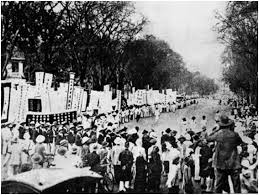
The procession and student rally around the funeral of Phan Chu Trinh in 1926

Below is a paper I wrote for Professor Alexander Cook’s Chinese Socialism in Global Perspective class Spring 2014. I discuss the historiography of Vietnamese youth and student movements and generational politics in the early twentieth century.


This paper examines the historiography of Vietnamese youth and student movements in the first half of the twentieth century. Given that the literature on Vietnamese student movements is relatively limited, I examine how student­­­s and youth movements are discussed in larger studies on the political atmosphere of 1920-1945 Vietnam. From these studies, I highlight how research on modern Vietnam has often been framed through the lens of generational politics—where political actors respond to the inadequacies of previous generations and intellectual shifts moves historical time forward. The first half of this paper examines the work of foundational scholars in modern Vietnamese history, Hue-Tam Ho Tai, David Marr, Pierre Brocheux, and Daniel Hémery, and explores their use of periodization and generations to discuss students and political radicalization. The second half explores the categorization of students in the work of Scott McConnell and historian of China Fabian Lanza. Drawing briefly from two monographs by Richard Wolin and Arif Dirlik, I conclude with some reflections on student movements and cultural politics of Vietnam on a comparative and thematic level.[1]

In the following examination of texts, I also ask the following methodological questions regarding writing histories of movements and ideology. How do scholars understand historical origins and legacies of ideology and movements without falling into teleology and simplistic causation? For example, how do scholars write the political history of early twentieth century Vietnam without framing a Marxist-Leninist style revolution as historically inevitable? How have scholars positioned debates in culture in the understanding of revolution? Does the historical categorization of ‘student’ and generational politics reveal or obscure our understanding of the Vietnamese revolution?

Continue reading “Generational Identities and Cultural Politics: A Historiography of Vietnamese 1920’s and 1930’s Student Movements”

BOOK REVIEW Christopher Goscha’s Going Indochinese: Contesting Concepts of Space and Place in French Indochina

indochinese

Goscha, Christopher E. Going Indochinese: Contesting Concepts of Space and Place in French Indochina. NIAS Classics Series,; No. 3. Copenhagen, Denmark,: NIAS Books, 2012.

Originally an essay (“Vietnam or Indochina”), Going Indochinese details the historical attempts to create ‘Indochina’ from the period of French conquest to Vietnamese Communist assertions regional socialist solidarity in the 1950s. Goscha makes two primary arguments: 1) at certain moments Vietnamese intellectuals and administrators thought of themselves in “Indochinese” terms; and 2) Cambodians and Laotians rejected the construct of Indochina due to the imbalanced “Franco-Vietnamese” hierarchy.

His first chapter closely examines how ‘Indochina’ was constructed based on the notion of Franco-Annamese collaboration, the labor of Vietnamese low level administrators and officiers, and the internal colonization/immigration of Laos and Cambodia in the first decades of the twentieth century. Goscha supports his claim that ‘Indochina’ was a functional concept and space with evidence from the colonial administration (and racial hierarchies of Vietnamese above Laos and Cambodia), maps, transportation networks, textbooks, and Vietnamese travel narratives. The second and third chapters consider how Vietnamese intellectuals and revolutionaries debated the identification of Annam with French Indochina. Goscha expands the category of colonial ‘nationalist’ to include (those who reflected on the political-cultural-spatial identity of ‘Annam’) such as pro-French intellectuals as Bui Quang Chieu (Constitutionalists), Pham Quynh, and Nguyen Van Vinh. Focusing on the 1930-1931 debate between Pham Quynh and Nguyen Van Vinh, Goscha illustrates the pervasiveness of the construct of ‘Indochina’ among Vietnamese, as well as the problematic exclusion of Laos and Cambodia within the discussion. Goscha argues that the functional identity of ‘Indochina’ also shaped Vietnamese revolutionary debates for an Indochinese communist revolution throughout the 1920s and 1930s. This manifested in heated debates by Ho Chi Minh, the VNQDD (regarding the usage of terms such as Vietnam or Indochina), as well as the organization of the Indochinese Communist Party and Indochinese Congress. The next chapter discusses Cambodian and Laotian perspectives on ‘Indochina’ and the inter-Asian (Vietnamese, Indian, Chinese) contacts facilitated by racist colonial administrative structures and commercial networks. Goscha explains how the French created a hierarchy of legal identities for ‘indigenous’ and Vietnamese immigration to Western Indochina exacerbated ethnic and nationalist tensions in the region. Through the example of the Vietnamese-Cambodian debate and local administrative authority in Laos of the 1930s, Goscha emphasizes the importance of the question of Indochinese colonial nationality, assimilation, and local authority for Vietnamese living in Laos and Cambodia.

Goscha’s last chapter on Vichy Indochina (1941-1945) demonstrates the last French attempts to reinstitute the construct of a three-monarch Indochina (Bao Dai of Annam, Sihanouk of Cambodia, and Sisavangvong of Laos) in patriotic cultural campaigns. During the same time, Communists also attempted to invoke the concept of Indochina as a unifying force against the French. On the eve of Indochina’s independence in August 1945, the communist-run nationalist front the Viet Minh advocated an independent ‘Vietnam’ while the Communist Party stuck to the concept of ‘Indochina’ even after the declaration of the Democratic Republic of Vietnam. This confusing, interchangeable use of ‘Vietnam’ and ‘Indochina’ into the 1940s and 1950s reinforces Goscha’s claim of the important regional thinking of “Indochina” and that “Indochina was not dead in Vietnamese communist thinking.” Goscha argues that Vietnamese communists simultaneously created nationalist fronts of the Pathet Lao, Khmer Issarak, and Cambodian and Lao resistance governments as socialist allies in the postcolonial 1950s. He concludes that the Vietnamese communists were the closest in ‘going Indochinese’.

Historiography: Going Indochinese: Contesting Concepts of Space and Place in French Indochina responds to Benedict Anderson’s question as to why Dutch East Indies transformed into the postcolonial political entity of Indonesia while Indochina fragmented into the three nation states of Laos, Cambodia, and Vietnam. Influenced by Anderson’s question and concepts of ‘imagined community,’ Goscha explores the ways in which the bureaucracy, the map, textbooks, and roads contributed to a building of Indochina as a spatial reality. Overall, this is an important work that analyzes the pervasiveness of the geo-political construct of ‘Indochina’ throughout Vietnamese debates on nationalism, communism, and regional cultural coherence.
Qualifying Examinations Presentation Tips

phd0111

(These are tips from other graduate students and professors, and directed mainly at history oral exams.)

PRESENTATION
Start with “That’s a good/important question.”
Enumerate your answers. This provides structure to an answer, makes it easier to follow, and also offers a natural cadence to end your response to a question.
Reformulate the question. Do this if you don’t understand the question. This also helps to open your response.
Frame the response as if in a written argumentative response (thesis, supporting argument, conclusion).
Do not just fill up time. Make sure to just answer the question and not provide tangentially related information.
Ask for clarification. If you do not know the answer of the question or do not understand, make sure to ask for refinement of the question.
Use historiography as a way to clarify and situate argument. But do not get lost in the historiographical details. Focus on the question asked.
Strive for concise answers. Concise answers convey confidence and clarity. If you provide a short answer, you can also add “I can also elaborate more on this point if you would like.”
End your response with confidence and with a period. Don’t use ellipses or end a response suddenly when you have run out of things to say.

BOOK REVIEW Shawn McHale’s Print and Power: Confucianism, Communism and Buddhism in the Making of Modern Vietnam

Screen Shot 2016-04-15 at 5.05.28 PM

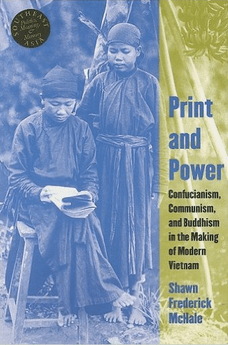
McHale, Shawn. Print and Power:  Confucianism, Communism and Buddhism in the Making of Modern Vietnam. Honolulu: University of Hawaii Press, 2004.

In the foundational study on print culture in Vietnam, Print and Power addresses two important arguments: (1) The historiography of 20th century Vietnam has overemphasized the significance of communism and anti-colonial nationalism and focused on the small group of urban, educated elite intellectuals. (2) Rather, Buddhism was more important to Vietnamese public life and was the cornerstone of Vietnamese national identity. Thus Mchale’s text contributes to a more complex understanding of the rise of the ‘public sphere’ (or rather the multiplicity of spheres such as clandestine, religious, traditional spheres) in Vietnam as well as a deeper understanding of the development of Buddhism during 1920to 1945.

Continue reading “BOOK REVIEW Shawn McHale’s Print and Power: Confucianism, Communism and Buddhism in the Making of Modern Vietnam”

Qualifying Examinations Preparation Tips

phdcomic1

A compilation of tips for examination prep in history that has helped me these past few months.

PREPARATION
 Before reading:  Read book reviews
 Strategize a logical order to approach your texts (themes, authors,   historiographical interventions, how much time you have)
 While reading:  Make chapter by chapter one sentence summaries in your notes
 Pinpoint key historical actors
 Make sure you understand the historic periodization
 After reading:
 Use index cards or zotero notes
 Make 1 paragraph summary of a book/article.
 Situate text within historiography
 Review:  Create a framework of all the themes on your book list to remember and understand how your books relate/differ from one another.
 Make index cards of possible questions on one side, and concrete answers on the other side.
   Share and communicate your notes, ideas, and questions online and with colleagues!


BOOK REVIEW Richard Wolin’s The Wind from the East: French Intellectuals, the Cultural Revolution and the Legacy of the 1960s

k9127

Generational Identities and Cultural Politics: A Historiography of Vietnamese 1920’s and 1930’s Student Movements

I led a discussion of Richard Wolin’s Wind from the East in Professor Alexander Cook’s history of Chinese Socialism class spring 2015. Below is my discussion plan for the class including an author biography, argument summary, discussion questions, and a list of the events and figures discussed in the book.


Richard Wolin is Professor of History, Comparative Literature, and Political Science at the City University of New York Graduate Center of European Intellectual history. His most famous books include Heidegger’s Children and The Seduction of Unreason. Wolin also writes about the Frankfurt school and Walter Benjamin and is also a public intellectual and contributes to the New Republic, Dissent, and the LA Times. From his interview, Wolin speaks about his intellectual lineage, influence by Frankfurt school, and  study under Habermas. Wolin experienced the 1960s as an adolescent and narrowly avoided service in the Vietnam War.

Overview:

“French Maoism operated at a dangerous remove from the reality principle. Mao’s China became a projection—a Rohrschach test—for the students’ overheated revolutionary fantasies. With Soviet communism substantially discredited, revolutionary China, along with other third-world experiments in state socialism (North Vietnam, Cuba, and so on), seemed to embody the last best hope for a left-wing alternative to the dislocations of Western modernity: overcrowded cities, urban blight, ghetto uprisings (in the United States, at least), industrially scarred landscapes, and massive pollution.” (Rediscovering Marxism with Althusser)

Continue reading “BOOK REVIEW Richard Wolin’s The Wind from the East: French Intellectuals, the Cultural Revolution and the Legacy of the 1960s”

BOOK REVIEW Vu Trong Phung’s Luc Xi: Prostitution and Venereal Disease in Colonial Hanoi, trans. Shaun Kingsley Malarney

51-DpOlMSiL._SX335_BO1,204,203,200_

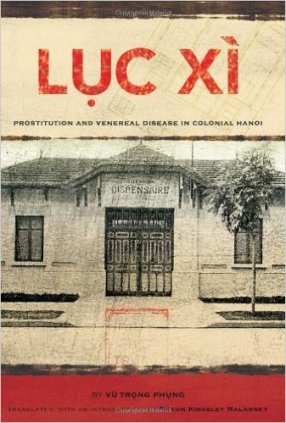
Vũ Trọng Phụng, Lục Xì: Prostitution and Venereal Disease in Colonial Hanoi, trans. Shaun Kingsley Malarney (Honolulu: University of Hawaiʻi Press, 2011)

This book review was originally published by the International Institute of Asian Studies New Books Asia review here: http://newbooks.asia/review/cost-progress

“How is it that while we are in this city of ‘a thousand-year civilization’ there is for every thirty-five upstanding people one person working as a prostitute?”[i] Vietnamese reporter Vũ Trọng Phụng poses this controversial question in the first installment of his 1937 study on prostitution and venereal disease in Hanoi titled Lục Xì. Shaun Kingsley Malarney brings this important work to an English language audience through this careful translation and extensively researched introduction. Not only does this work contribute to the growing understanding of Vũ Trọng Phụng and his literary works, but it also offers crucial insight into the limited history on the poor, women, prostitution, medicine, and disease during the colonial period.

Continue reading “BOOK REVIEW Vu Trong Phung’s Luc Xi: Prostitution and Venereal Disease in Colonial Hanoi, trans. Shaun Kingsley Malarney”

A Culture of Sharing: Reading Publicly & Making Transparent the Ivory Tower

study

Exam Preparation & “Reading” Publicly for an Online Audience

For several months I have been preparing for my  Ph.D. qualifying exams in history at UC Berkeley. It can be an incredibly isolating process, where I read for hours with no clear sense of end in sight. Since I’m not teaching this semester, all these ideas that I’ve encountered in reading has felt quite stagnant and purposeless. These books marinate in my head rather than out there being challenged and questioned in an undergraduate classroom or grad seminar.

Something that has brought meaning and order to all these ideas is publishing summaries, thoughts, and questions here on my blog! The anticipation of an audience and the pressure of being ‘published’ online challenges me to refine my ideas more clearly. I liken this process to “reading publicly”. By sharing my reading lists, summaries, thoughts, and questions on these books, I hope to make a visible archive of my ideas.

Making Transparent the Ivory Tower of Academia

Often the ivory tower of academia is portrayed as self-serving and removed from the larger community. Pushing against the image of the isolated ivory tower of intellectualism, I aspire to make the research, reading, and writing process more transparent through my own work. My mission for my website consists of two parts:

  1. Contribute to the body of online knowledge on Vietnam.
  2. Share my experience as a graduate student and researcher.

My hope is that these thoughts and summaries can be useful to someone else out there who is planning coursework, interested in Vietnam, or curious about history. The English language information on Vietnam out there on the internets is quite limited, or incredibly weighted towards the Vietnam War. Furthermore, I seek to share the process of research as one of exploration, experimentation, and communication.

I want to contribute to a culture of sharing things in progress. Working papers, thoughts, typos, unpolished ideas.