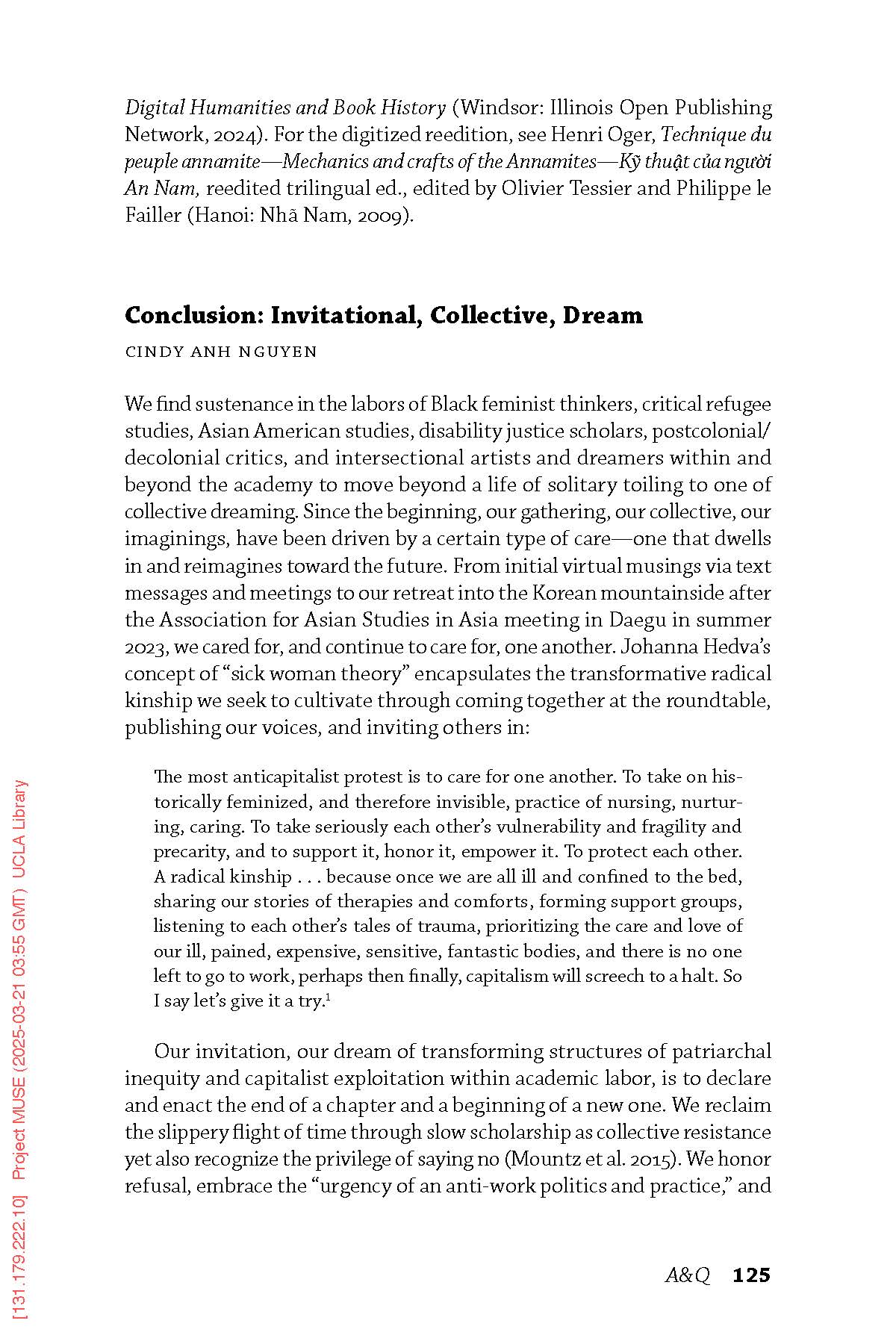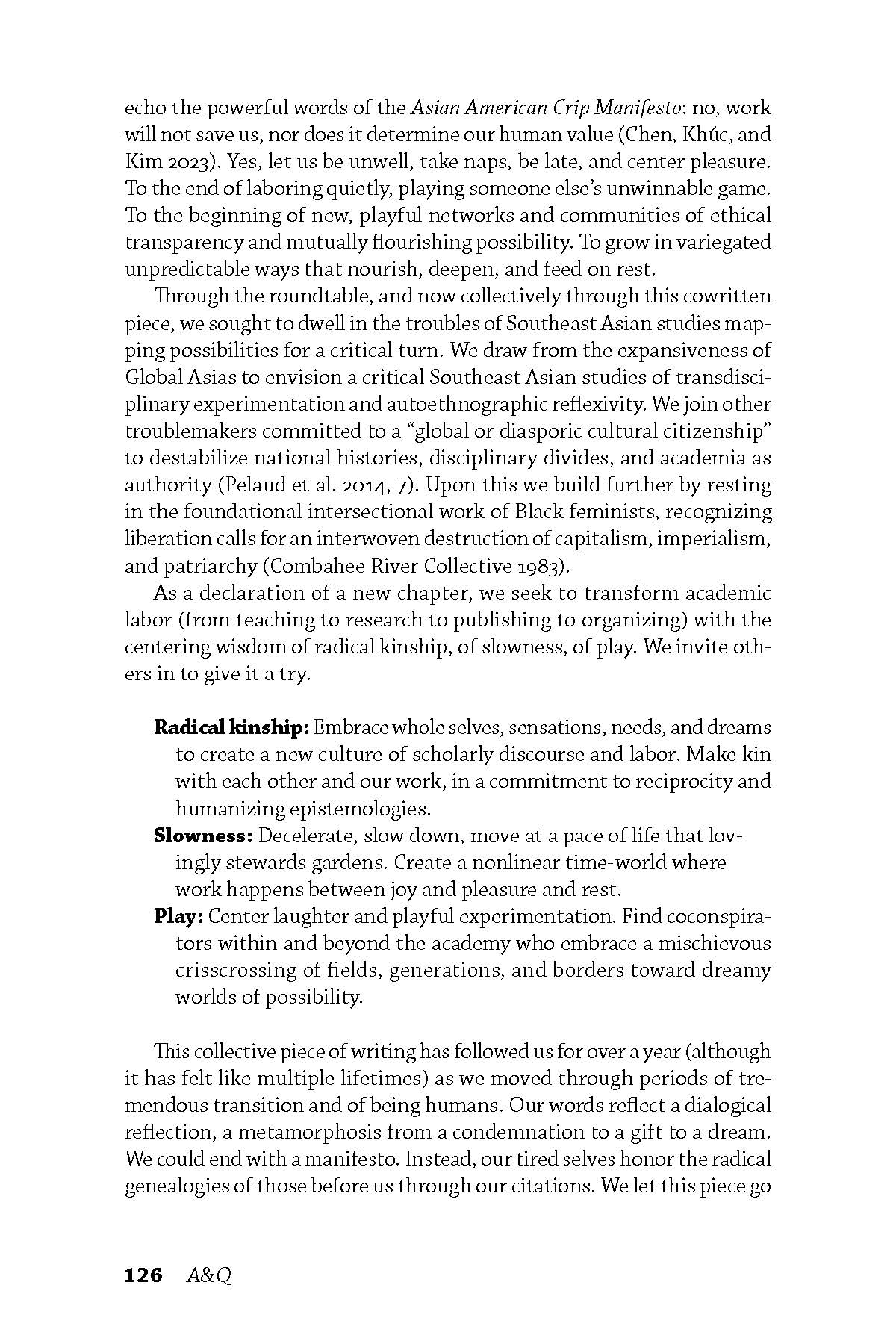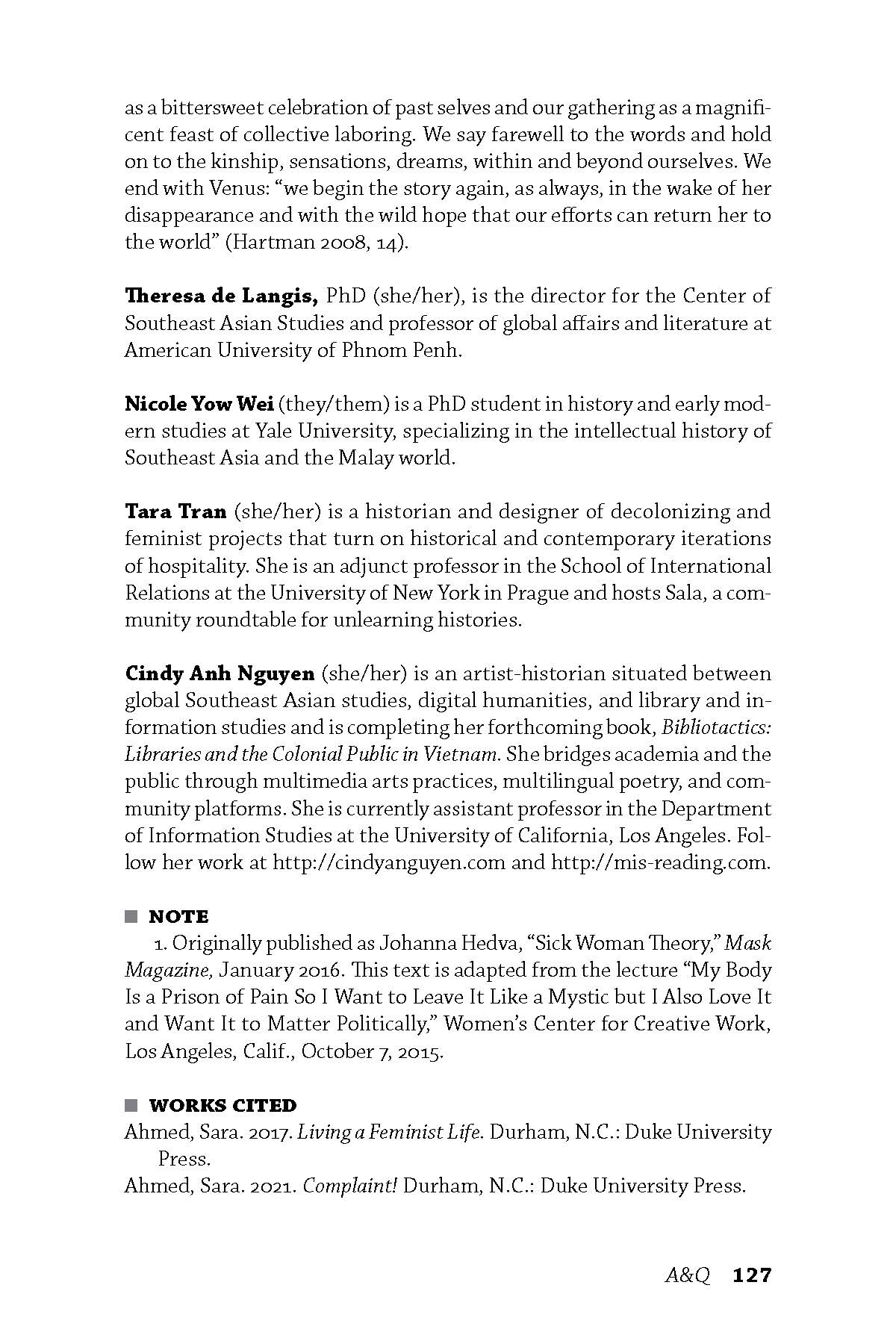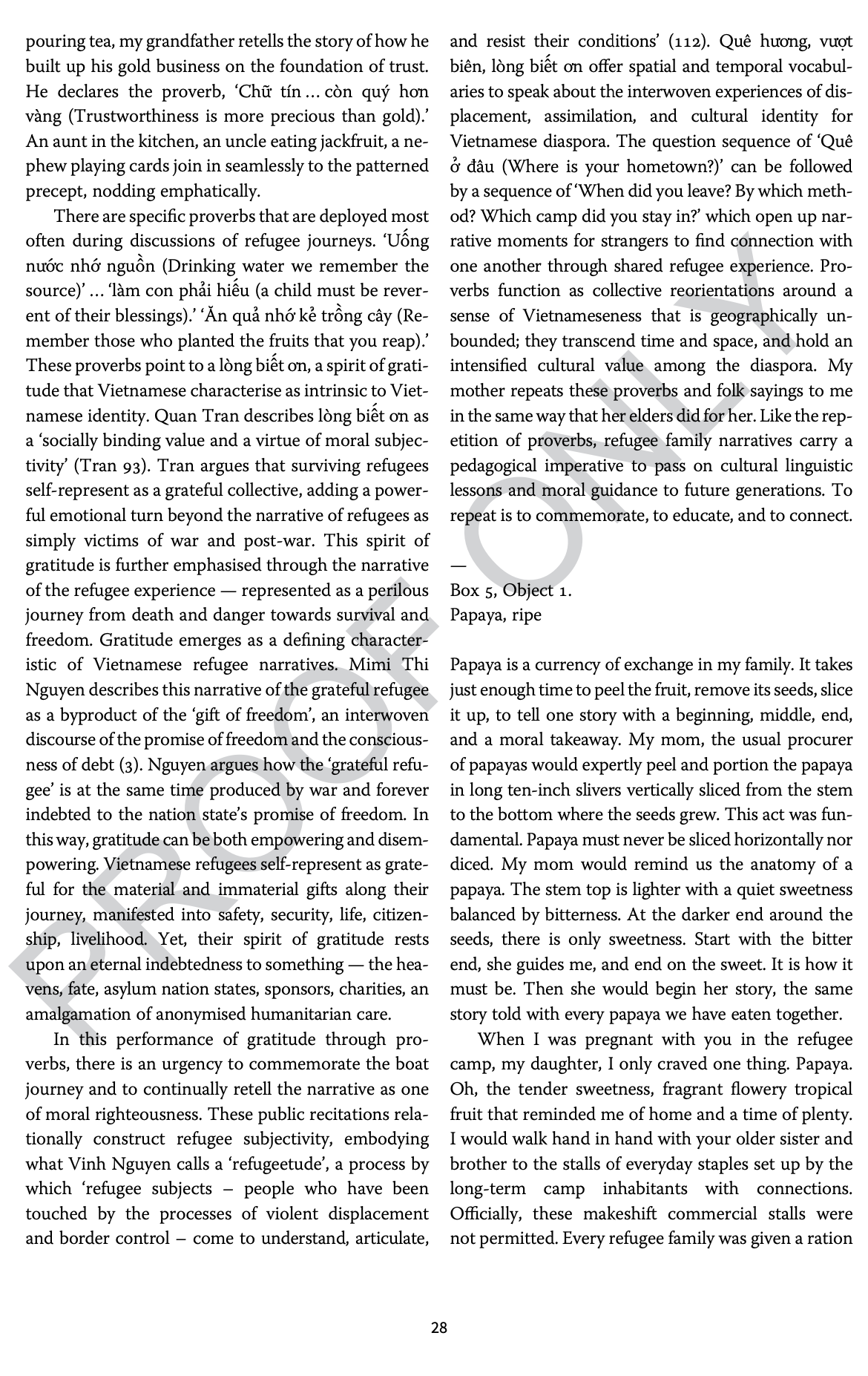
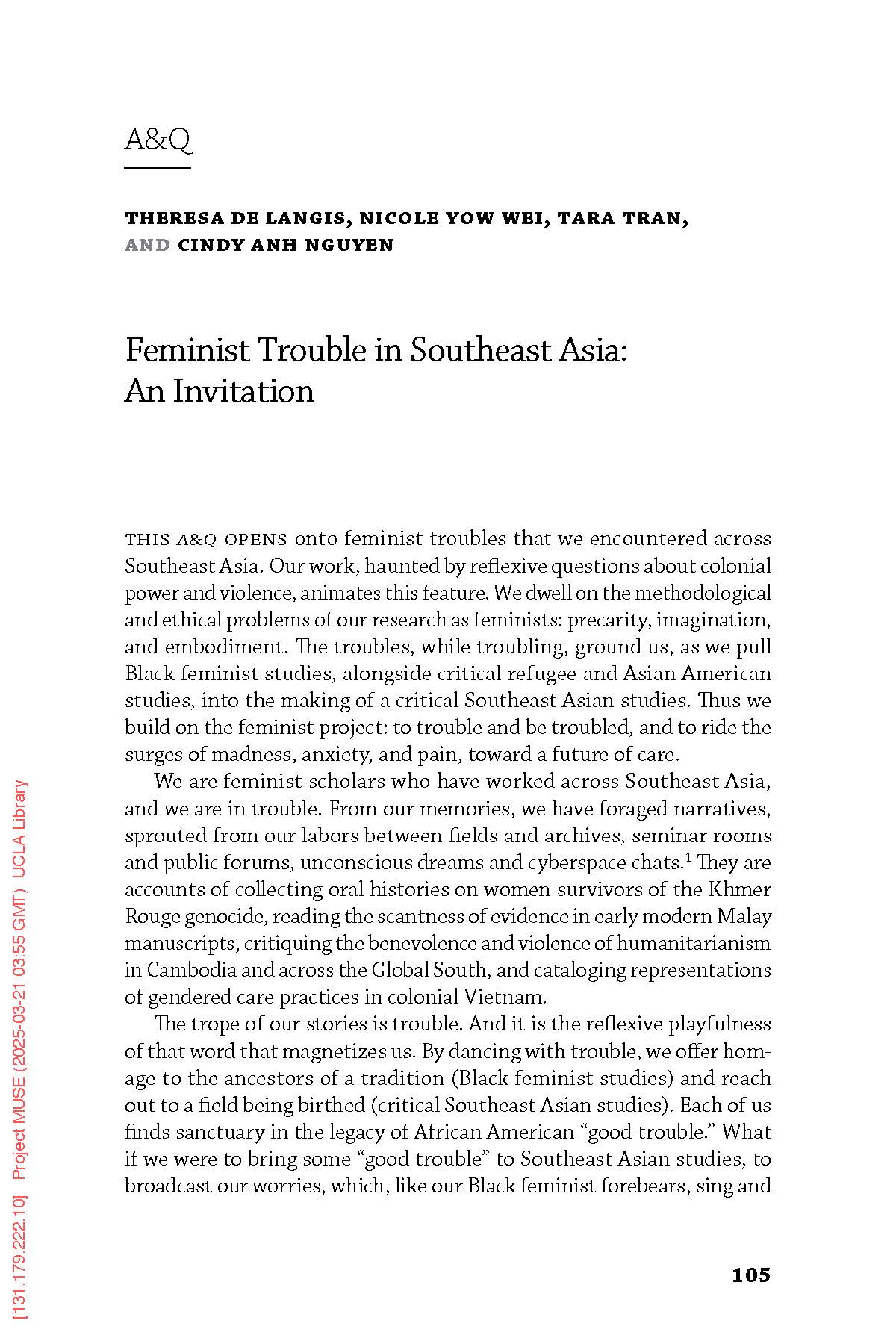
Feminist Trouble in Southeast Asia: An Invitation by Theresa de Langis, Nicole Yow Wei, Tara Tran, Cindy Anh Nguyen [New Publication]

Truly honored to share the excerpts of our publication “Feminist Trouble in Southeast Asia: An Invitation”. It’s been a privilege to work together with fellow troublemakers Tara, Theresa, and Nicole, to redefine academic ‘work’ through relationships and centered on care. What appears like an academic article is more like an imprint of our collective gatherings, dreaming, and cowriting that spanned summer 2022 (submission to AAS in Asia roundtable- part community gathering part academic real talk) to the gathering in the mountains of South Korea in 2023, to finally its written linear format in spring 2025. As I alluded to in my “Collecting Through Absence” piece, this has been a long transitional period of turning towards a different type of scholarly identity and community artist, a feminist troubling of knowledge and narrative, that celebrates relationality, experimentation, and transdisciplinarity–a surrender into the world of “what if” rather than creating from a world of “what is”. This truly is an invitation, please do reach out to join us, dream/make with us. Follow along here: http://mis-reading.com/trouble/

For published article, see

Theresa de Langis, Nicole Yow Wei, Tara Tran, Cindy Anh Nguyen (2025) “Feminist Trouble in Southeast Asia: An Invitation”, Verge: Studies in Global Asias, 11:1, 105-130, DOI: https://doi.org/10.1353/vrg.2025.a951540

For other pieces in this issue: https://muse.jhu.edu/issue/54274

If you leave a comment with your email/ or email me at cnguyen@seis.ucla.edu, happy to send you the full article without paywall….(shadow library link to file)

Excerpts of Introduction, Conclusion and Citations
Excerpt from my subsection “Care As Knowledge, Care as Labor: Toward Relationally and Making Kin”

I make visible to readers my dreams in all their fragmented mess: to weave together the intellectual, personal, and collective threads in a reflexive troubling tapestry that makes visible care as knowledge and labor. I begin with my historical research on care, abruptly recognize the care work of academic labor, and close with an invitational collective dream of a future informed by feminist and decolonial kinship. I center Haraway’s (2016, 1) reminder that future making is not of imagined safety or of clearing dangers of the past and present but is instead to “make kin in lines of inventive connection as a practice of learning to live and die with each other in a thick present. . . . Staying with the trouble requires learning to be truly present, not as a vanishing pivot between awful or edenic pasts and apocalyptic or salvific futures, but as mortal critters entwined in myriad unfinished configurations of places, times, matters, meanings.”
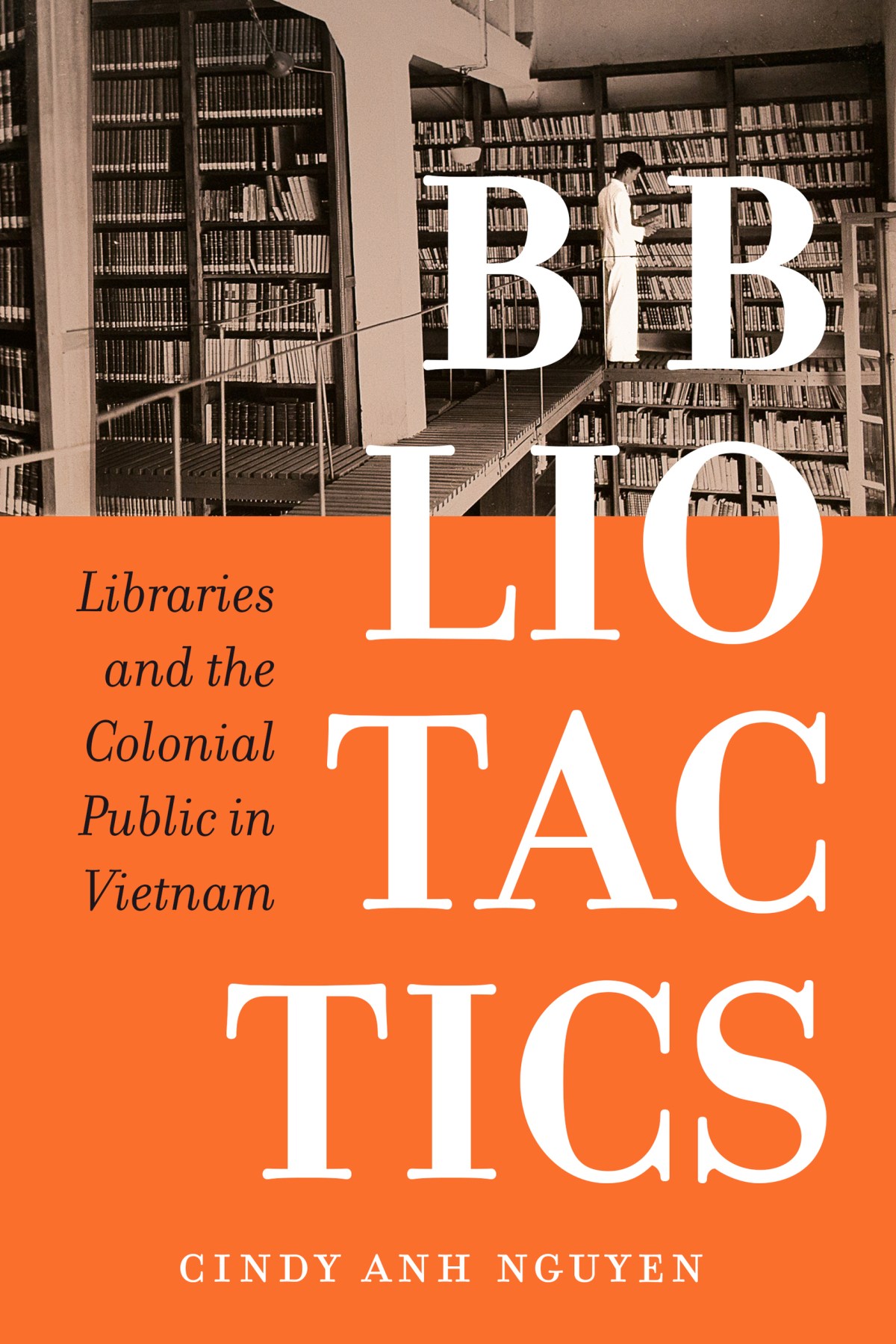
Announcing…BIBLIOTACTICS! Available now for Preorder with UC Press 30% off

My forthcoming book Bibliotactics: Libraries and the Colonial Public in Vietnam is now available for preorder from UC Press with the promo code UCPSAVE30. Be the first to pick up your print copy to be published and shipped by January 13, 2026. Open access editions through Luminos will also be available that date worldwide. Online ordering of print copies through UC Press is available for US and Canada. Other locations can order by selecting Amazon, Barnes & Noble, or Bookshop. https://www.ucpress.edu/books/bibliotactics/paper

You can also follow along with talks, events, excerpts on my book website at http://bibliotactics.com ! If you’d like to schedule an upcoming book talk or event, please reach out to me at cnguyen@seis.ucla.edu

Screenshot

Feminist Decolonial Futures: Tactics of Teaching Digital Humanities [New Publication]

Link to Publication on Journal of Interactive Technology and Pedagogy:

https://cuny.manifoldapp.org/read/feminist-decolonial-futures-tactics-teaching-digital-humanities/section/7ec4034b-77d8-4722-9ab1-e63b8e6e0aef

Excerpt: “This piece is part of a commitment to sharing and creating human communities of care alongside the materialist structures of support that constrain the everyday, such as time and resources. Interwoven with feminist and decolonial praxis, this piece includes a collection of critical pedagogy tactics, as well as syllabi excerpts from two digital humanities classes and an information studies class, and concludes with experimental dream classes for digital humanities. I also draw from my decade of teaching across disciplines and K–16 curricula and my commitments to critical pedagogy to reflect upon the specific experiences of teaching digital humanities courses this past academic year (2023–2024) that focused on historical data and visualization with a commitment to feminist and decolonial approaches. This past year, I taught a graduate introduction to digital humanities course with a focus on project management and public communication and a capstone undergraduate course focused on French colonial Vietnamese historical data. I also taught a graduate course on global libraries and decolonial futures primarily for graduate students completing their master’s degree in library and information science. I facilitated specific assignments and transparent reflexive modes of communication in a frenzied pursuit of an alternative to the current status quo, a current world marked by invisibilized labor and erasure of disabled whole selves, where students and instructors carry a hegemonic weight of capitalistic linear time defined by benchmarks, grades, progress, bureaucratic evaluations, and pursuit of transferable skills to serve an anonymized impossible market. Drawing wisdom from communities of laboring scholar activists and artists, I conclude with aspirational models for teaching and researching digital humanities that center the whole selves of students and instructors as part of the world and committed to decolonial futures.”

Backstory: This publication took decades to write, in part, because it was an embodiment of so many life stages–graduate school, job market, postpartum, covid, now on the tenure clock. In earlier stages, it was written here during a collective writing sprint session: https://cindyanguyen.com/2023/12/08/on-slowness/ This new version of the piece is also my grappling with teaching this first academic year at UCLA…a former version of myself wouldn’t have necessarily connected the dots that the first year as professor, the classroom space was so deeply consumed by discussions of academic labor, and the ‘vibe’ of our class was so deeply anti-capitalist, anti-institutional, and exhausted in every direction.

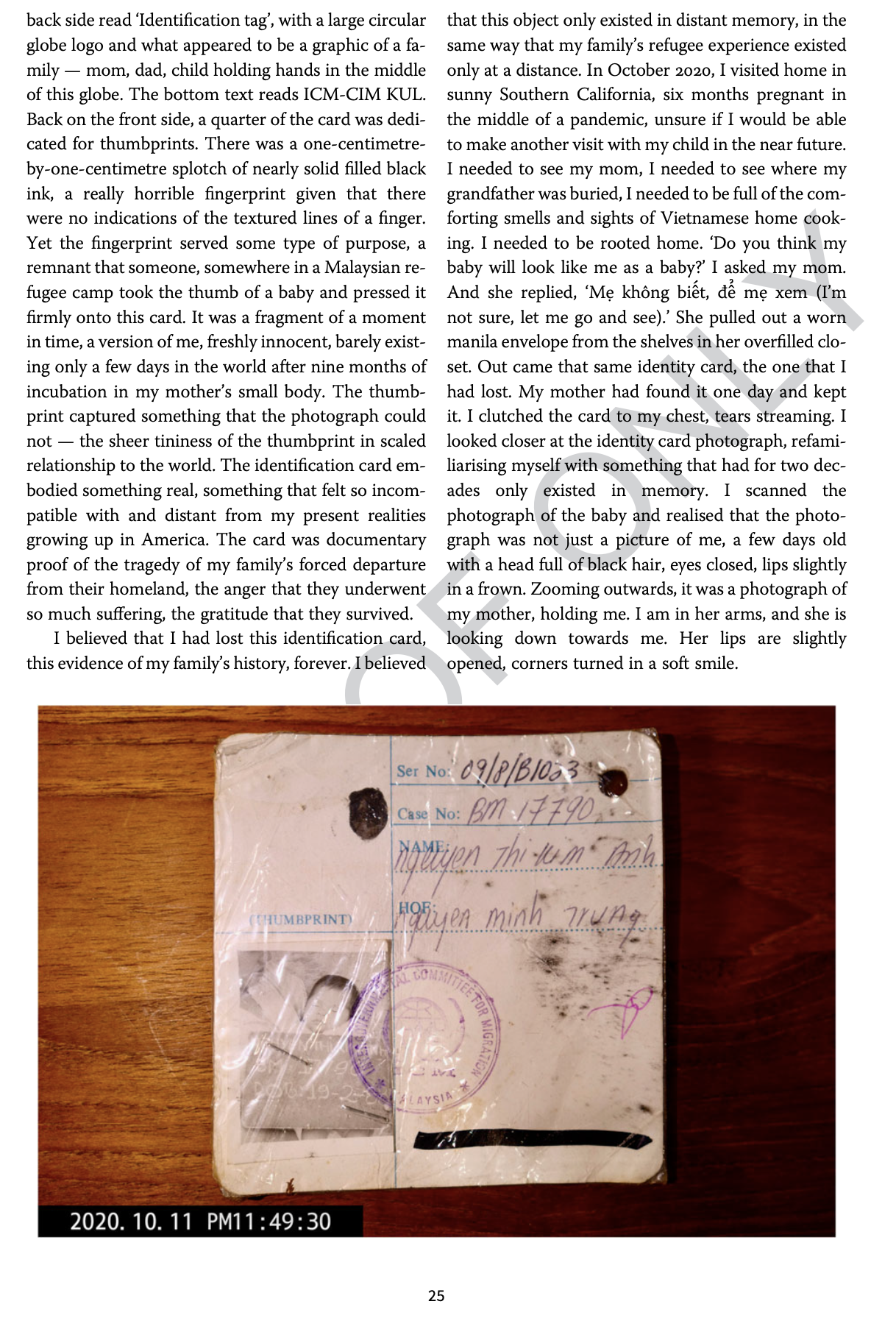
Collecting through Absence: Fragmenting Vietnamese Refugee Archives by Cindy Anh Nguyen [New Publication]

Truly honored to share the pre-print of my latest publication. This piece was produced in conversation with this ambitious special issue on the ‘littoral zone’ and the expansive ways in which we think/create/imagine Southeast Asian studies. Yet this piece also had several before lives, workshopped in literary arts communities and women’s writing groups that emboldened me to bring together my commitments to academia and arts in a singular embodied piece of writing. This piece marks my own transitional littoral moment, a turning of the chapter towards a different type of scholarly identity and community artist, a feminist troubling of knowledge and narrative.

For published essay, see

Cindy Anh Nguyen (2023) “Collecting Through Absence: Fragmenting Vietnamese Refugee Archives”, Wasafiri, 38:4, 22-30, DOI: 10.1080/02690055.2023.2237770

For other pieces in this special issue: https://www.tandfonline.com/toc/rwas20/38/4?nav=tocList

Excerpted from the opening essay by editors Nazry Bahrawi, Joanne Leow, and Y-Dang Troeung:

Etymologically derived from the Latin litus (shore), the word littoral refers to something that is ‘of or belonging to the seashore’. In oceanography and marine biology, ‘the littoral zone’ is the area of closest contact between the land and the water: the intertidal zone, the high-water mark, estuaries, straits, the continental shelf, and more. In the military, the littoral zone is associated with littoral warfare involving combat operations oscillating between water and ground. The littoral also invokes associations with edges, beaches, waterlines, litter, sediment, and drift. The littoral zone offers a rich metaphor for thinking through contact between material spaces such as the land and the sea, and conceptual spaces such as empire and ecology.

Surrounded by oceans, seas, and straits, with its multiple histories of maritime empires and nations, Southeast Asia lends itself particularly well to the study of the littoral zone, as source of livelihood for so many but also as subject of historical and contemporary colonial and postcolonial land reclamation and maritime disputes. From the colonial eras to the post-Cold War moment, Southeast Asian seas, straits, and estuaries have seen the transport of indentured workers, migrants, refugees, trafficked people, deportees, and many other racialised peoples whose bodies and labour have been rendered surplus.

In conversation with communities of artists and scholars in Southeast Asia, we have curated this special issue on Southeast Asia and the littoral. The littoral zones of Southeast Asia are contested spaces and in constant flux: the issue’s focus on postcolonial Southeast Asian texts (from Singapore, Cambodia, Malaysia, Indonesia, Philippines, Vietnam, and Myanmar) aligns with Wasafiri’s long-standing focus on the themes of empire, colonialism, and decoloniality. Thus, a combination of critical, creative, and artistic works is necessary to capture the elusive and mutable nature of these ecologies and landscapes. The selection of contributions – that range from creative writing, traditional scholarship, visual art, poetry, photography, interviews, reviews, and hybrid format works – provide place-based testimonies and glimpses into the complex experiences of existing on the shoreline.

‘A Xu/sou for the Students’: A Discourse Analysis of Vietnamese Student Migration to France in the Late Colonial Period

This was originally published as a book chapter in Nguyen, Cindy A. 2015. “‘A Xu/sou for the Students’: A Discourse Analysis of Vietnamese Student Migration to France in the Late Colonial Period”. In Transnational Migration and Asia: The Question of Return, edited by Michiel Baas, 135–56. Amsterdam University Press. http://www.jstor.org/stable/j.ctt1963142.11.

Below is an early proof version of my chapter:

CHAPTER 9

“’A Xu/Sou for the Students:’

A Discourse Analysis of Vietnamese Student Migration to France in the Late Colonial Period”

Cindy A. Nguyen

Summary

This chapter examines the physical and emotional experience and representation of Vietnamese student migrants between metrópole and home within the first decades of the twentieth century. Amongst the circulation of ideas on civilization, individualism, and nationalism, newspaper debates questioned the meaning and role of ‘the student’ within a rapidly changing, modern and one-day independent Vietnamese nation. However, rather than assume colonial study as simply a producer of radical intelligentsia, this chapter considers how the discourse of ‘the student’ was shaped both by the obligation to return to Vietnam and the students’ rejection of that cultural world. For some individuals, civilizational discourse and the opportunity for education abroad was the emancipation from both family and outmoded social expectations. For others, this sense of individuality inherent within student migration, reified the feeling of apartness brought by physical distance and cultural estrangement. Through studying the rhetoric of sending Vietnamese abroad, this chapter demonstrates the symbolic power and responsibility that an educated youth carried in relation to shifting definitions of the home—both familial and national.

Continue reading “‘A Xu/sou for the Students’: A Discourse Analysis of Vietnamese Student Migration to France in the Late Colonial Period”

BOOK REVIEW Vu Trong Phung’s Luc Xi: Prostitution and Venereal Disease in Colonial Hanoi, trans. Shaun Kingsley Malarney

51-DpOlMSiL._SX335_BO1,204,203,200_

Vũ Trọng Phụng, Lục Xì: Prostitution and Venereal Disease in Colonial Hanoi, trans. Shaun Kingsley Malarney (Honolulu: University of Hawaiʻi Press, 2011)

This book review was originally published by the International Institute of Asian Studies New Books Asia review here: http://newbooks.asia/review/cost-progress

“How is it that while we are in this city of ‘a thousand-year civilization’ there is for every thirty-five upstanding people one person working as a prostitute?”[i] Vietnamese reporter Vũ Trọng Phụng poses this controversial question in the first installment of his 1937 study on prostitution and venereal disease in Hanoi titled Lục Xì. Shaun Kingsley Malarney brings this important work to an English language audience through this careful translation and extensively researched introduction. Not only does this work contribute to the growing understanding of Vũ Trọng Phụng and his literary works, but it also offers crucial insight into the limited history on the poor, women, prostitution, medicine, and disease during the colonial period.

Continue reading “BOOK REVIEW Vu Trong Phung’s Luc Xi: Prostitution and Venereal Disease in Colonial Hanoi, trans. Shaun Kingsley Malarney”