
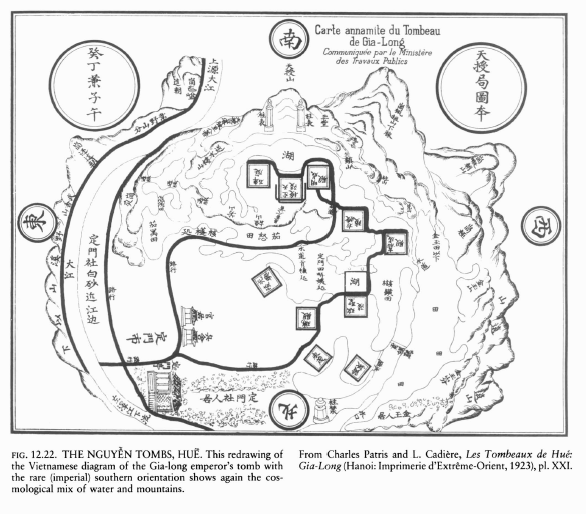
Below is a old paper I found when I was writing through ideas of place, nation, and pre/early modern Vietnamese history. From the work of Liam Kelley’s Beyond the Bronze Pillars, I question how understandings of place shape concepts of nation and boundary. I wrote this paper in a class with Professors John Whitmore and Victor Lieberman at University of Michigan, Ann Arbor.
For more on Vietnamese geography, and map-making, see
—
Expressions of Borders and Place through the Sino-Vietnamese Relationship
Throughout the late colonial period and increasingly afterwards, questions of the modern sovereign nation have permeated political debates and academic studies on Southeast Asia. More recent scholars such as Benedict Anderson and Victor Lieberman examine even further the global nuances and multifaceted processes that encompass the development of a theoretical political identity, characterized as an “imagined community” or “political ethnicity.”[1] In particular, Lieberman’s forthcoming book challenges the problematic circumscription of the relatively modern European concepts of ‘nation’ and instead considers early modern understandings of ‘political ethnicity’ in a study of synchronous political development in Eurasia.
While incredibly important, the debate on the foundational meanings of political communities is beyond the scope of this paper. Rather, this paper attempts to contribute a facet of political identity through a study on the sense of belonging to and perception of ‘place.’ Here I use a theoretical understanding of place as an intimate relationship between individual and geographical space: “For humans, both the effects of space on our behavior and our use of space are mediated by place.” [2] I highlight the experience and construct of place mediated through the movement away from one’s place of familiarity. Specifically this paper explores the travels of Vietnamese envoys to China in the sixteenth to nineteenth centuries and the poetry they composed along their journeys. The sources examined in this paper are based primarily on Liam Kelley’s book, Beyond the Bronze Pillars: Envoy Poetry and the Sino-Vietnamese Relationship, where Kelley provides a historical framework and extensive translations of sixteenth to nineteenth century Vietnamese envoy poetry.[3]
Continue reading “Expressions of Borders and Place through the Sino-Vietnamese Relationship”


 Cindy A. Nguyen