My mom speaks a particular linguistic formula of Vietnamese.
Take two generations of refugees,
Multiply it by memory, nostalgia, and fierce loyalty,
Subtract contemporary Vietnamese đổi mới economic changes and internet slang,
Add some Catholic guilt, the weekly Penny Saver free section, and just enough American English to avoid jury duty.
And as a result, we have the language of 1990’s Little Saigon, California:
We just moved here. = Tôi mới ‘mu’ (move) đây.
You have a duty to your family. = Con có ‘bổn phận’ (antiquated Sino-Vietnamese to mean obligation, citizen’s official liabilities) với gia đình.
The market has a sale. 5 pounds of apples for 1 buck. = “Chợ đang có ‘seo.’ Năm ‘paon’ táo cho một ‘bức.’
It’s a familial language of living history.
It’s a parental language to instill morality and gratitude.
It’s a mother’s language of survival.
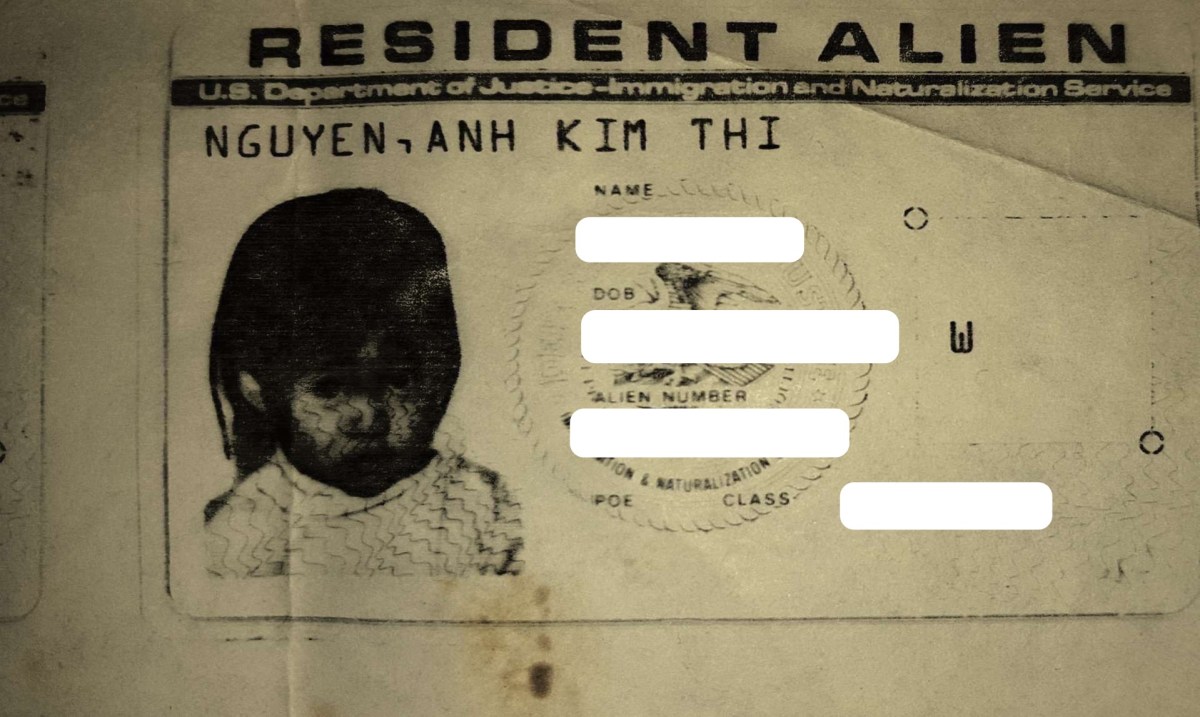
And it was the language that I was raised on. Before I found my time structured by recess, arts and crafts, and English grammar, I absorbed the world around me. I helped my mom cut away the loose threads of her day’s garment work. I watched Vietnamese children’s karaoke and learned about sweeping the house, playing with fireworks, and cooking for your grandparents. Sitting cross-legged on the floor, I traced my mom’s handwriting of my name, Nguyễn Thị Kim Anh.
Utterances of sacrifice, duty, and reputation inserted themselves between meals and commercial breaks. These were the Vietnamese words that guided my everyday. But then I started to learn a new language at school. This language had other rules, speech patterns, and ideals. It was unlike the religious creeds my grandmother whispered, or the ethics of family forever first.
New authority figures who did not look like my parents told me,
“Good job!”
“You can be whoever you want to be.”
“Everyone is different. Cindy has a flat nose.”
“You plagiarized. Your English essay is too good.”
And classmates who were supposed to be something called ‘peers’ told me,
“You are a Communist.”
And I would say, ”No I’m not. I came to America on a boat.”
And then everyone would laugh.
A different set of pronouns and names governed my existence.
At school I was the neutral pronoun “I” and the newly chosen name “Cindy Nguyen,” (“Cin-dy Win,” I would enunciate slowly each day during roll call. Yes, it’s okay, you don’t need to bother with my real name.)
At home I was a child (con) and the affectionate term of endearment “little one” (bé). But more often than not, you would find me in trouble—a disappointment to my entire family, kneeling in the corner and thinking about all of my sins. At that time my parents called me by my Vietnamese name, “Kim Anh”. Or on worse days, they called me, “someone else’s child” (con nhà ai).
I never questioned if I was ‘fluent’ in English or Vietnamese. Until that stale suburban afternoon during my third grade parent-teacher conference, when my mom screeched “My children talk English good! She not ESL. She do good job in school.”
I remember it very clearly as a screech because all the little hairs along the back of my neck stood on end. I replayed in my head not what my mother said, but how she said it. I wanted her to stop speaking, because it resembled the scratching of distorted static—the slow undoing of velcro shoes (something I yearned for) during Catholic confession (something I feared). She sounded foreign, bizarre, comedic even. That day I learned that the English language could be something called ‘broken.’ And for the first time I was embarrassed of my mom.
And day by day, the Vietnamese language that I was raised on turned into a secret language. Take my mother’s version of Vietnamese, then
Multiply by 12 years of American public school peer pressure,
Subtract the ability to read and write Vietnamese,
Add some creative misunderstandings, unspoken teenage resentment, and dreams of the American sitcom family.
And as a result, we have the language of my Vietn-America. This language was contained within the perimeter of
The five apartments we lived in during my childhood,
The fifty person weekly reunions with extended family,
The five o’clock afternoon routine of sleepy Sunday mass.
My version of Vietnamese mechanically activates after I enter these spaces. Automatically, my head tilts downwards, my shoulders hunch, and the weight of loss, sacrifice, and misguided hope force my arms to cross over each other.
I lose the ability to look at someone in the eye.
I lose a vocabulary of expression, of empowerment, of individuality.
I lose the pronoun “I.”
School was good. = “Gút”
I’m sorry mom, I made you sad. = “Xin lỗi mẹ, con làm mẹ buồn.”
Thank you Mom and Dad, for taking care of us kids. = “Cảm ơn bố mẹ đã “trông sóc”… (Apparently this is not actually a word, as confirmed by the Vietnamese dictionary, but a creative combination of “trông nom” + “chăm sóc.”)
Your bittermelon soup was delicious! (I love you.) = “Canh khổ qua mẹ nấu ngon lắm!”
It’s a familial language of food (and love).
It’s a child’s language to ask for forgiveness.
It’s a girl’s language of broken translations and dreams.
—
Hanoi, February 2017









 Cindy A. Nguyen