ANNOTATED BIBLIOGRAPHY Pre/Early Modern Vietnam (Keith Taylor, Liam Kelley, Alexander Woodside, Li Tana, Choi Byung Wook, George Dutton)

Vietnamese Maps from Whitmore's "Cartography in Vietnam"

Below are my summary notes of part 1 of my qualifying exams list with Professor Peter Zinoman on Pre/Early Modern Vietnamese history.

  1. Pre/Early Modern
  2. Colonial
  3. Indochina Wars


PRE/EARLY MODERN

Historiographical chronology/ topical order

TEXTBOOK/STATE OF THE FIELD

  1. Taylor, Keith Weller “Surface Orientations in Vietnam: Beyond Histories of Nation and Region.” The Journal of Asian Studies 57, no. 4 (November 1, 1998): 949–78. + (shelf)
    1. Taylor challenges histories of oriented around nation and “Vietnameseness.” Taylor argues that histories are episodic rather than evolutionary, and function as surfaces upon material and cultural exchanges of which they are formed. He notes how South Vietnam, Nam Bộ has been seen as “less Vietnamese” due to contemporary definitions of Vietnameseness based on the North as the beacon of national origin and authenticity. Using the examples of six episodes of military conflict: the conquest of Lê Lợi (early 15th), Lê-Mạc ứa (16th), Trịnh-Nguyễn ứa (17th), Tây Sơn wars (18th), conquests of Nguyễn Ánh Gia Long (turn of 19th), Frenqu conquest (late 19th). Taylor calls scholars to orient histories towards a time and terrain and to be wary of connecting history with a linear assumption of change over time. In other words, Taylor encourages regional, temporally situated (of Trần Northern Coast, of Hội An and Quảng Nam as a fusion zone, of Nam Bo) studies rather than attempts to trace the entirety of the modern construct of the Vietnamese nation throughout history.

Continue reading “ANNOTATED BIBLIOGRAPHY Pre/Early Modern Vietnam (Keith Taylor, Liam Kelley, Alexander Woodside, Li Tana, Choi Byung Wook, George Dutton)”

Expressions of Borders and Place through the Sino-Vietnamese Relationship

Screen Shot 2016-04-09 at 1.46.30 PM

Below is a old paper I found when I was writing through ideas of place, nation, and pre/early modern Vietnamese history. From the work of Liam Kelley’s Beyond the Bronze Pillars, I question how understandings of place shape concepts of nation and boundary. I wrote this paper in a class with Professors John Whitmore and Victor Lieberman at University of Michigan, Ann Arbor.

For more on Vietnamese geography, and map-making, see

Expressions of Borders and Place through the Sino-Vietnamese Relationship

Throughout the late colonial period and increasingly afterwards, questions of the modern sovereign nation have permeated political debates and academic studies on Southeast Asia. More recent scholars such as Benedict Anderson and Victor Lieberman examine even further the global nuances and multifaceted processes that encompass the development of a theoretical political identity, characterized as an “imagined community” or “political ethnicity.”[1] In particular, Lieberman’s forthcoming book challenges the problematic circumscription of the relatively modern European concepts of ‘nation’ and instead considers early modern understandings of ‘political ethnicity’ in a study of synchronous political development in Eurasia.

While incredibly important, the debate on the foundational meanings of political communities is beyond the scope of this paper. Rather, this paper attempts to contribute a facet of political identity through a study on the sense of belonging to and perception of ‘place.’ Here I use a theoretical understanding of place as an intimate relationship between individual and geographical space: “For humans, both the effects of space on our behavior and our use of space are mediated by place.” [2] I highlight the experience and construct of place mediated through the movement away from one’s place of familiarity. Specifically this paper explores the travels of Vietnamese envoys to China in the sixteenth to nineteenth centuries and the poetry they composed along their journeys. The sources examined in this paper are based primarily on Liam Kelley’s book, Beyond the Bronze Pillars: Envoy Poetry and the Sino-Vietnamese Relationship, where Kelley provides a historical framework and extensive translations of sixteenth to nineteenth century Vietnamese envoy poetry.[3]

Continue reading “Expressions of Borders and Place through the Sino-Vietnamese Relationship”

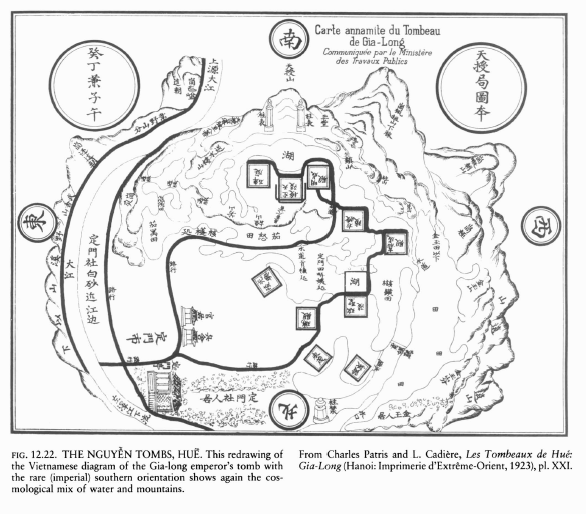
John Whitmore’s “Cartography in Vietnam”

Below are the images from the important article on Vietnamese map-making by John Whitmore:

Whitmore, John K. “Cartography in Vietnam.” In The History of Cartography, Volume 2, Book 2: Cartography in the Traditional East and Southeast Asian Socieites, 2:478–508. The History of Cartography Series. Illinois: University of Chicago Press, 1994.

Q. When does the ‘modern’ begin in Vietnamese history? A Historiography Essay (Alexander Woodside, George Dutton, Benedict Anderson, David Marr, Charles Keith)

Below is a historiographical paper that I wrote for Professor Peter Zinoman’s seminar on Southeast Asian Historiography in Fall 2015.

Modernity and the Modern Era in Histories of Vietnam: A Historiography Essay


Introduction

When does the ‘modern era’ begin in Vietnamese history? How does it compare to other eras in Vietnamese history? What are the characteristics of Vietnamese modernity? The question of ‘the modern’ consumes debates in colonial and post-colonial studies, and is often entrenched within debates regarding the nation state and Western imperialism. While the question of modernity and the modern era has been intensely debated in East Asia and South Asia, critical studies of modernity still remain limited in Southeast Asia and Vietnam.[1] In this essay, I will explore the question of the modern era in Vietnamese history and situate this within Dipesh Charkabarty’s post-colonial critiques of studies on modernity. I demonstrate that Vietnam scholars approach the topic of the modern era and modernity in three different ways: first, the modern era is characterized by political integration, centralization, and bureaucratic systems of rule; second, the modern era is characterized by ‘modern’ forms of bureaucratic governance, technologies, and consumerism often ushered in by Western colonial influences; or third, the modern era is tied to the modern nation-state. To frame this another way, Vietnam scholars have located the beginning of the modern era within institutions of centralization and bureaucracy from the fifteenth century to nineteenth century, in colonial capitalism and Western ideologies of the 1886 to 1945 French colonial period, or in the debates regarding the Vietnamese modern nation-state and nationalism in the twentieth century.

Continue reading “Q. When does the ‘modern’ begin in Vietnamese history? A Historiography Essay (Alexander Woodside, George Dutton, Benedict Anderson, David Marr, Charles Keith)”

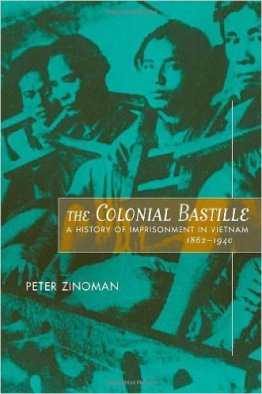
BOOK REVIEW Peter Zinoman’s Colonial Bastille: A History of Imprisonment in Vietnam 1862-1940

519RdZ1ImfL._SX329_BO1,204,203,200_
In the important study, Colonial Bastille: A History of Imprisonment in Vietnam 1862-1940, Peter Zinoman examines the transformation of the colonial prison as a system to maintain law and order into a social and ideological nexus for the development of communism, nationalism and anti-colonial resistance. Zinoman effectively argues that the colonial prison operated as “universities of revolution” to foment social connections of Vietnamese anti-colonial revolutionaries through the shared experiences of hard labor, living conditions, and sense of emotional loss within prison life. Thus, Zinoman extends the work of David Marr and Benedict Anderson to argue that the colonial prison was an ‘imagined community’ that forged fraternal revolutionary bonds and collective identities.

Continue reading “BOOK REVIEW Peter Zinoman’s Colonial Bastille: A History of Imprisonment in Vietnam 1862-1940”

ANNOTATED BIBLIOGRAPHY & KEY QUESTIONS: Southeast Asia Colonialism & Modernity

Questions and Themes: A few notes and text-based responses to themes on the list Colonialism & Modernity in Cambodia, Thailand, Burma, and Indonesia

Q. What is Colonialism? What are its instruments?
Anderson, Benedict R. O’G. “Studies of the Thai State: The State of Thai Studies.” In The Study of Thailand, edited by Eliezer B. Ayal. Southeast Asia Program. Athens, Ohio: Ohio University Center for International Studies, 1978.
Thongchai Winichakul. Siam Mapped: A History of the Geo-Body of a Nation. Honolulu: University of Hawaii Press, 1994.
     The normative understanding of colonialism is the dominance of a territory and people by a foreign force. This could manifest in the direct or indirect control of the political administration, extraction of economic resources and use of an indigenous labor force, and hegemonic influence of culture through education, language, and ethnic stratification. The results of colonialism can be social (plural society, fragmentation or hierarchy of ethnic groups), economic (vulnerability to foreign markets, trade monopolies, and dependency on foreign capital, and political (creation of a new layer of intermediary administrators, displacement of indigenous forms of governance and local authority).

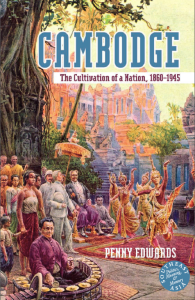
BOOK REVIEW Penny Edwards’ Cambodge: The Cultivation of a Nation 1860-1945 (2007)


Screen Shot 2016-04-03 at 10.35.18 AM

Edwards, Penny. Cambodge: The Cultivation of a Nation 1860-1945. University of Hawaii Press, 2007.

In the seminal work Cambodge, Penelope Edwards offers a complex genealogy of the modern nation, Khmer-ness, and the ‘Original Khmer’ (Kmae daem). Edwards demonstrates how cultural and national identity were interwoven with the construction of Angkorean antiquity throughout the French colonial period in Cambodia (1863-1954). Pushing against arguments of colonial hegemony as well as the elision of the colonial period from contemporary nationalism, Edwards argues that the development of an Angkor narrative was never monolithic. Instead, diverse groups of colonial administrators, European savants, Khmer elite intellectuals, and Buddhist reformers and leaders contributed various visions of Khmer-ness, culture, history, and modernity.

Continue reading “BOOK REVIEW Penny Edwards’ Cambodge: The Cultivation of a Nation 1860-1945 (2007)”

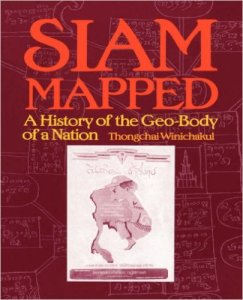
BOOK REVIEW Thongchai Winichakul’s Siam Mapped: A History of the Geo-Body of a Nation (1994)

51QKZO5Bn8L._SX403_BO1,204,203,200_

Thongchai Winichakul. Siam Mapped: A History of the Geo-Body of a Nation. Honolulu: University of Hawaii Press, 1994.

In Thongchai Winichakul’s innovative mongraph Siam Mapped, the discourse of geography and the modern map directly produce the political territoriality, values, practices, and geobody that would later become the modern Thai nation. Thongchai demonstrates how indigenous concepts of space are displaced by modern geographic and mapping science. At the same time, local and indigenous concepts of space should not be evaluated through Western understandings of ‘scientific merit’ but understood to serve different purposes (such as traiphum cosmology).

Continue reading “BOOK REVIEW Thongchai Winichakul’s Siam Mapped: A History of the Geo-Body of a Nation (1994)”

BOOK REVIEW Benedict Anderson’s Imagined Communities: Reflections on the Origin and Spread of Nationalism (1983, 1991, 2006)

andersonAnderson, Benedict R. O’G. Imagined Communities Reflections on the Origin and Spread of Nationalism. Rev. ed. London; New York: Verso, 2006.

In Imagined Communities, Benedict Anderson argues that the nation is a new, modern phenomenon. The 17th and 18th century witnessed the demise of previous forms political bodies that were shaped by a sacred language, sacred cosmology and dynastic power, and sense of historical temporality shaped by cosmology. Material conditions and rationalist perception of ‘homogenous empty time’ created the structures where individuals could conceptualize themselves as part of an ‘imagined community.’ The imagined community is one in which members will not know most of their fellow members, is finite with limited boundaries, sovereign power, and a community of fraternal, horizontal comradeship. It is through the emergence of print-capitalism—the technological, mass production of newspapers and the novel and the spread of vernacular print languages—that individuals could think of themselves and relate to others in different ways. This possibility to envision parallel and plural realities connected individuals to other individuals to form a concept of an ‘imagined community.’

Continue reading “BOOK REVIEW Benedict Anderson’s Imagined Communities: Reflections on the Origin and Spread of Nationalism (1983, 1991, 2006)”