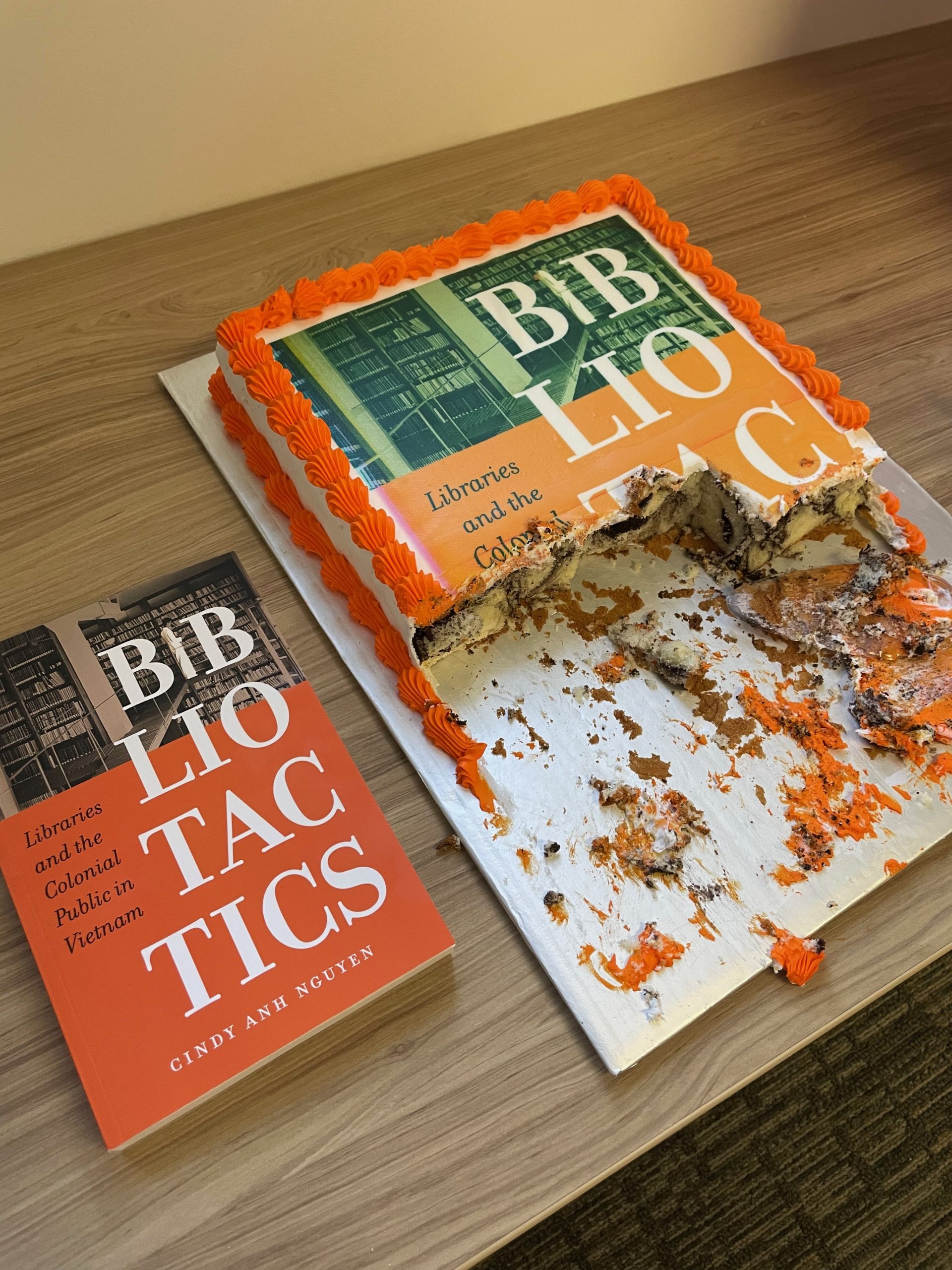
Below are a flurry of recap of the past month: Spring in person and virtual events, New Books Network Podcast, a book cake, oh my!
“Hoa Bằng depicted books as desirable food objects with attractive scents and providing spiritual nourishment. He noted how urban readers already had a certain “addiction” to this type of literary consumption and encouraged the spread of reading tastes more evenly throughout society to rural readers. ” p. 132 Bibliotactics
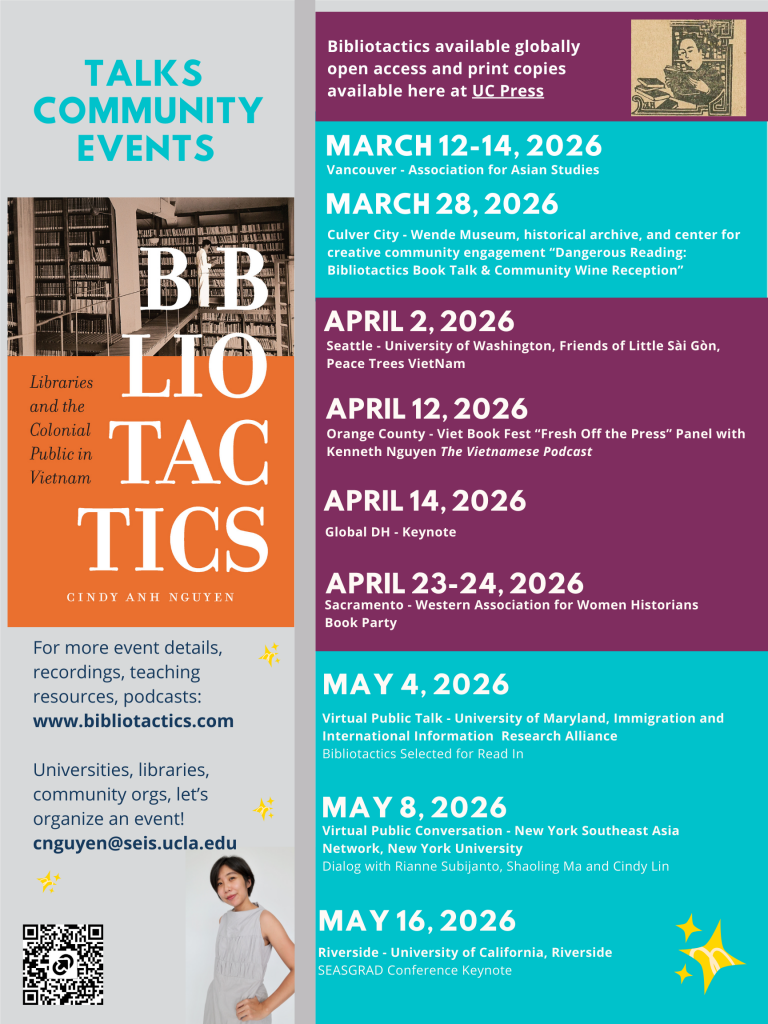
April 23-24: Western Association for Women Historians, Sacramento – Book Party
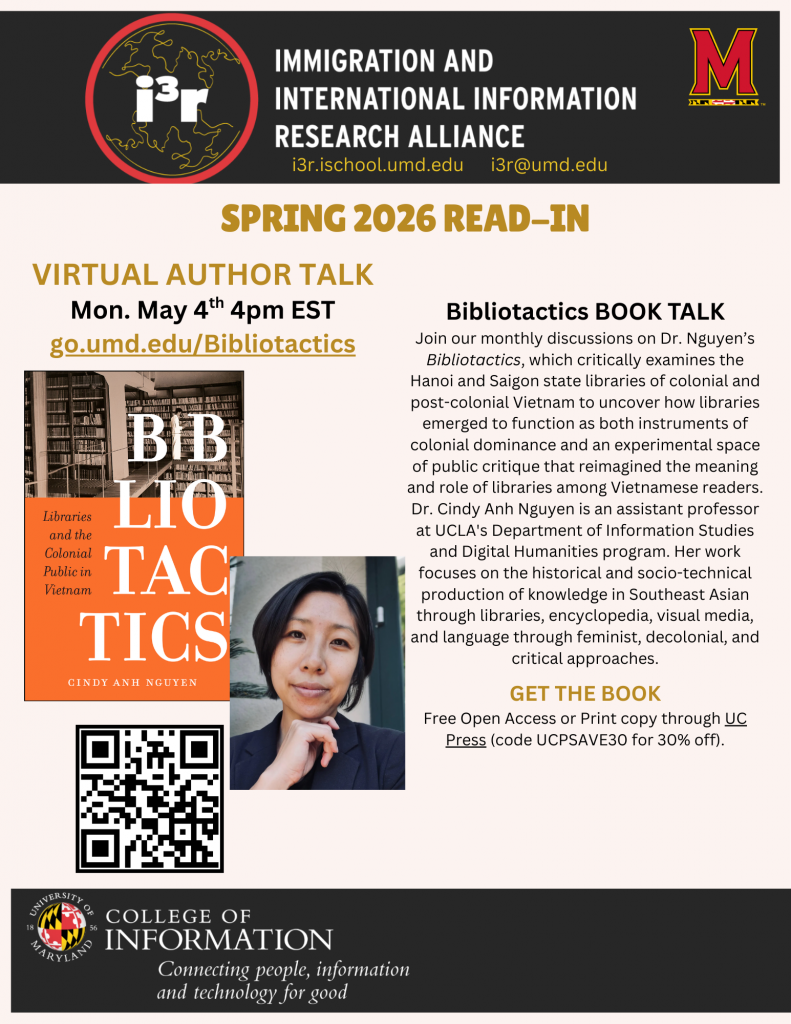
May 4: University of Maryland, Immigration and International Information Research Alliance, Bibliotactics selected for Read in – Virtual Author Talk, Zoom registration here
May 8: New York Southeast Asia Network, NYC – Virtual Conversation with Rianne Subijanto, Shaoling Ma, and Cindy Lin
May 16: SEASGRAD Conference Keynote, University of California, Riverside
Join us in Saigon for experimental community talks around reading, feminism, and art. It’s an honor and dream to “start” my book tour in Saigon (where the intellectual/personal/political journey began) alongside feminist cothinkers Minh and Yen.
Nguyễn Art Foundation is pleased to present a two-part event (8 & 9 August) that brings together scholars and practitioners exploring the complex entanglements between reading, gender, institutional power, and historical memory in Vietnam and its diasporas. Moving across colonial archives, library histories, and literature, the program rethinks the act of reading – not as passive consumption, but as a site of resistance, imagination, and world-making. Through diverse lenses – feminist critique, critical fabulation, and institutional analysis – these speakers interrogate who gets to read, what is considered public or private, and how gendered dynamics shape literary and cultural encounters. The program highlights how readers, particularly women, have long negotiated visibility, agency, and power through their engagement with texts.
Day 1 – 8 August: Library History as Data-Art-Life: Fabulating the Vietnamese Past with Dr. Cindy Anh Nguyen
This talk is an invitation into the experimental transdisciplinary approach of Dr Nguyen’s book ‘Bibliotactics: Libraries and the Colonial Public in Vietnam’. Beyond an academic book of Vietnamese history, it is a work of critical fabulation through visual archives, data aesthetics, and experienced architectures. Interweaving method and theory, the author centers historical agency of Vietnamese library readers in colonial institutions, to ultimately trouble questions of power and publicity. This talk moves from static and disciplinary framings of History towards a dynamic crisscrossing of data-art-life that centers absence, imagination, and relationality.
Day 2 – 9 August: Women’s Reading: Theory and Practice with Dr. Cindy Anh Nguyen and Dr. Yen Vu. Moderated by Dr. Nguyen Thi Minh
1/ ‘Women Library Reading Publics and Redefining Publicity in Late Colonial Vietnam’ by Dr. Cindy Anh Nguyen
This presentation explores how late colonial Vietnamese women were central to redefining discursive and functional meanings of publicity. Through tracing the creation of “bình dân thư viện,” these communal and public library initiatives questioned the various political meanings of “bình dân,” the commoner, the people, or accessible to the general public. The author will show how “public” could mean access to a wide range of people, including women, provincial readers, and youth; social welfare for the commoner and disenfranchised; or collective national identity through shared vernacular language and literary heritage. As a public space for cultural exchange, self-erudition, and intellectual discourse in a shared language, Vietnamese public libraries functioned as bottom-up experiments in forming imagined communities of readers and public citizens.
2/ ‘Reading women against the grain: A feminist method among masculine voices’ by Dr. Yen Vu
Can our work still be feminist even if the materials we work on are masculine and exclusionary? How can we read the textual representation of women in a way that is not bound by their definition as characters represented by men? In this talk, Dr. Vu draws from her experience negotiating with gender representation her my own research on francophone writing, dominated by masculine voices. The author will present the case of Tran Van Tung’s francophone novel ‘Bach Yen ou la fille au coeur fidele’ (1946) to exemplify how we can still pose critical questions in line with a feminist epistemology despite the text’s masculinist predispositions. Beyond the gender dynamics of the nationalist cause, the author will also focus on the formal construction of the novel, and how text emerges beyond the intentions of the author.
Bio:
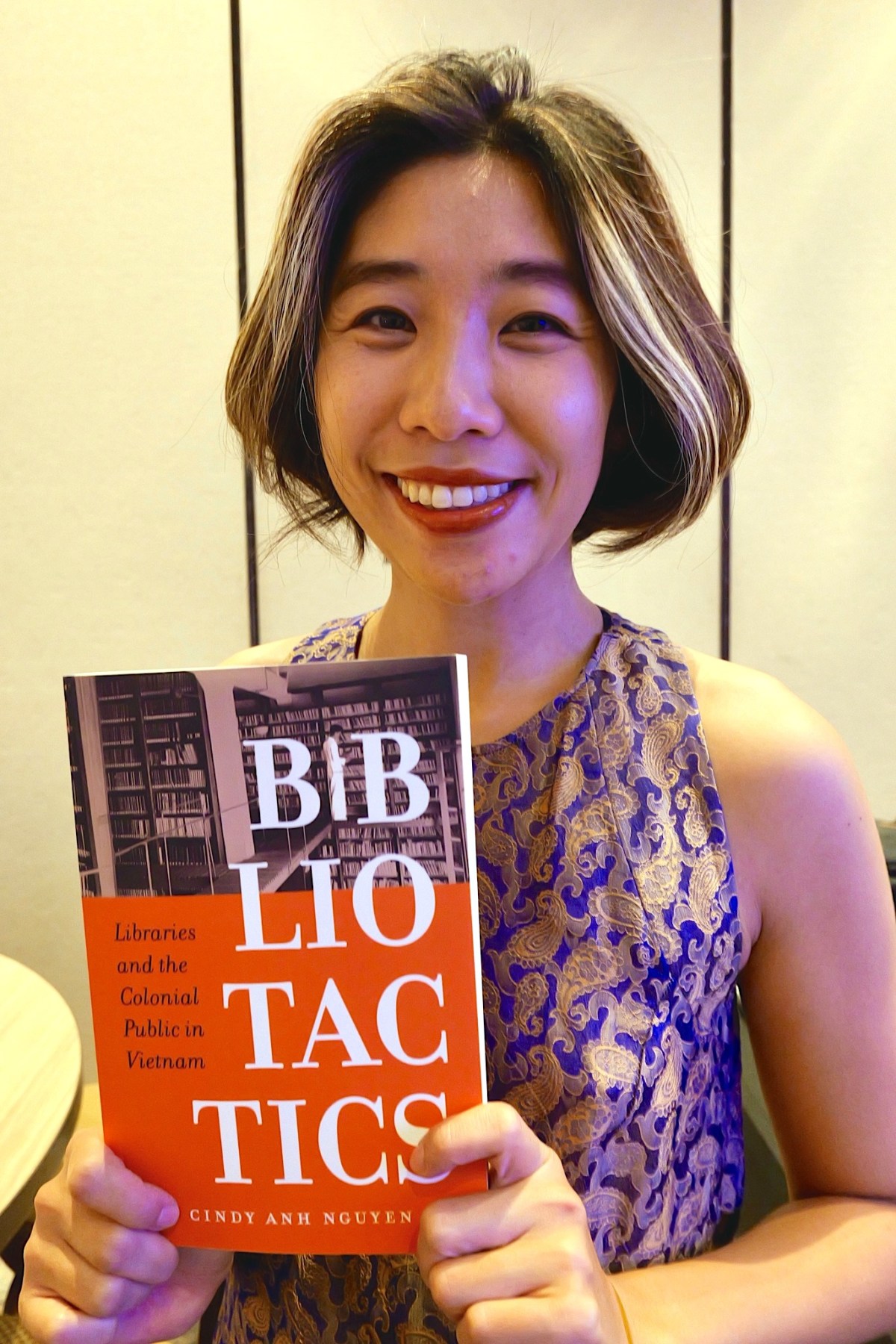
Cindy Anh Nguyen is Assistant Professor at the University of California, Los Angeles with appointments in Information Studies, Digital Humanities Program, and Asian Languages & Culture. Her forthcoming book ‘Bibliotactics: Libraries and the Colonial Public in Vietnam’ (University of California Press, 2026) uncovers how libraries functioned as both instruments of colonial dominance and an experimental space of public critique. Her work has appeared in Journal of Vietnamese Studies, Verge: Studies in Global Asia, Journal of Interactive Technology and Pedagogy, the Vietnamese American Refugee Experience Model Curriculum, Wasafiri, Ajar Press, Diacritics, and exhibitions such as ‘Textures of Remembrance: Vietnamese Artists and Writers Reflect on the Vietnamese Diaspora’.
Yen Vu teaches at Fulbright University Vietnam and is a scholar of 20th century Vietnamese literature. Her book project ‘Language as form, the politics and poetics of writing in French in 20th century Vietnam’ explores questions of language, freedom, and intellectual history. She received her PhD from Cornell University and subsequently held appointments in the French Department at Hamilton College and at the Weatherhead East Asia Institute at Columbia University. Her writing has appeared in Journal of Southeast Asian Studies, Diaspora, and Environmental Humanities. She also co-hosts a podcast called Nam Phong Dialogues that makes Vietnamese history accessible to the general public.
Nguyen Thi Minh is a tenured lecturer in the Faculty of Linguistics and Literature, Ho Chi Minh City University of Education. She was a visiting scholar at the University of Oregon (2018), a Fulbright scholar at the Asian American Studies Department, UCLA (2022–2023). In addition to translating multiple classical works in philosophy, gender, and cultural studies from English to Vietnamese, Minh works in comparative literature and film adaptation based on gender studies and semiotics, with her latest research publications featured in Hypatia: A Journal of Feminist Philosophy and Landscape Research in 2025. She is collaborating with the Vietnam Women Publishing House to build the Women’s Book: Gender and Development series to promote Vietnamese gender studies. Minh is the co-founder of The Ladder, an inclusive community learning space, which is making academic knowledge more accessible for everyone, especially the Vietnamese youth.
In the past, I was frustrated by how slow my work moved. I was impatient that my critical inquiry, confusion, curiosity forced me to constantly revisit sources, translations, historical contexts. Market pressures to publish and produce (a talk, an article, a dissertation, a book, teaching, digital resources) with the promise of professional security perpetuated a structure of external validation of scholarly production.
As I begin this new position at UCLA and transition into my professorial role, I’ve been reflecting on my messy and vibrant intersections of intellectual, personal, and political commitments. My transdisciplinary work in Southeast Asian history, community arts, digital humanities, and collaborative multimodal learning are all unified by an approach of ‘world building.’ I examine worlds past through historical and digital humanistic inquiry. A world building approach recursively makes space for the interwoven work of critique-reimagination of worlds past, present, and future.
At the heart of worldbuilding is an intention to slowness.
I undertake a slow critical approach in world building to take time to wander, wonder, pause, and be deeply embedded in cultural social worlds. I strive towards an ethical responsibility to understand primary sources and data and their affordances of production. I work and walk alongside others in intentional collaborations of knowledge making, honoring overlapping and divergent motivations and interests. We journey in collective writing sprints, organize feminist gatherings of knowledge sharing, workshop rough ideas, and enact tactics of creating near future and distant future realities. Scholarship is a communication ecosystem–through classroom engagements, public talks, side conversations, I revise and revisit my thinking in a persistent commitment to learn and unlearn. All of this work, this quiet labor and recursive journeying is both painfully and pleasurably slow.
Slowness in Teaching (Part 1)
Teaching through pandemic and navigating infrastructures of labor exploitation has left me beyond exhausted. Intentional slowness in teaching is a tactic of self-preservation and invitation towards rest. I counter both internal and external pressures to continually ‘improve’ or ‘innovate’ my teaching with a set of slow tactics:
Each time I teach a course, I permit myself to only ‘innovate’ (change the structure of the course) in either content or form. That means, I only change the reading/topics or change the structure of assignments/modality.
I offer assignments that invite in slowness from students rather than structurally add more. For example, rather than another paper or project, I task students with a portfolio assignment that recompiles and reflects on previous work within the classroom.
Topics are substantively aligned vertically instead of pressures towards horizontal expansion. We take ‘one thing’ and create opportunities to dive deeper, offering space for comparative wonderings but recognize that expertise in all the things is impossible. A final project that hones into the ‘one thing’ allows students to slowly explore.
At the heart of slowness is creating a class culture and community. As instructor, I dedicate time to learn about students through:
Revisiting personal goals and experiences in the middle of term through a check in questionnaire. Example
Creating space to celebrate and commemorate the class journey through a shared activity such as collective ‘yearbook’. See extended discussion of yearbook celebration and other assignments in my Teaching Workshop
I joined the Virtual Angkor team late their dissemination stage as a teaching fellow, committed to rethinking how to ‘teaching’ with virtual heritage resources. I designed the following teaching module guided by the question “What does it mean to tour the past?” We carry this out firstly through a slow observation based learning (where often in university environments it’s all about fast, skimming, speed reading, losing the experiential wonderment of it all.) I organized this teaching module be a collective meditation on meaning making, guiding questions, vocalizing understanding, figuring out collectively an unfamiliar historic moment and social world of thirteenth century Angkor.
In this workshop, Dr. Nguyen invites participants to practice a ‘slow viewing, slow listening, slow thinking,’ process of meaning making in virtual reality that can be taught in classrooms focused on world history, global Asias, and digital media and design. Dr. Nguyen leads an exploration of Virtual Angkor, a virtual reconstruction of the medieval Cambodian capital of Angkor that seeks to explore the diversity and complexity of Southeast Asia in digital heritage studies. Virtual Angkor reappraises the neglected region of Southeast Asia as a dynamic and important center for understanding global processes of premodern urbanisms, climate change, and ‘non-western’ forms of governance and power. This workshop invites participants to enter a VR space to listen, examine, and question. The experience aims to facilitate a ‘critical making’ understanding of the past which undermines the romanticized representations of the exoticized orient or the ruins of Angkor that permeate both the French colonial record and the contemporary tourism industry complex of Cambodia.
Slowness in Research (Part 2)
My Decolonial Data Pedagogy Lecture with Fulbright-Hays (Middlesex Community College and Lowell Public Schools) Group (linked to above) has been a culmination of a slow alignment of my pedagogical and research commitments towards imagining a post/anti/decolonial approach to my research on colonial histories and knowledge production. Slowness was at the crux of this material-computational analysis of this peripheral text, Technique du Peuple Annamite,that haunted-mesmerized me since graduate school. After eight years of working on a different project (history of libraries) amongst other life things, I return to this work in full gusto. The slowness of ‘figuring out’ this text through close reading, material analysis, collaborative analysis, and computational modeling has given this work the timespan it needed to breathe and imagine. Digital humanities is not just method, but invited a commitment to decolonial data critique and to platform a decolonial imagining, a building of an alternative world beyond/in contestation with its colonial confines.
Slowness as Method
My regular check in: “Is this new idea/approach/methodology substantive or additive?”
As of late, I’ve been repeatedly told: “You have so much energy!” “You’re so productive!” and I often blink back in cognitive dissonance to the comments because they shroud the quiet, recursive labor of what it means to do teaching and scholarship on the everyday. Folks see the product, not the process.
I’m slowly trudging through a mess and I embrace it. Slowness is a feature not a bug (particularly in virtual reality and computational analysis). Slowness is an invitation to critique and contextualize. Slowness is a pedagogical imperative to permit students to be curious again, to reflect and to celebrate. Slowness is a license to pause, rest, and do nothing.
On Slowness, A Feminist Reader (in progress)
Agamben, Giorgio. 1978/1993. Infancy and History: The Destruction of Experience. London: Verso.
Ahmed, Sara. 2017. Living a Feminist Life Durham: Duke University Press. Ahmed, Sara. 2021. Complaint! Durham: Duke University Press.
Casarino, Cesare. 2008. Time matters: Marx, Negri, Agamben, and the corporeal. In Cesare. Casarino & Antonio Negri (eds), In Praise of the Common. Minneapolis: University of Minnesota Press, pp. 219-246.
Combahee River collective. “A Black Feminist Statement.” April 1977, Boston, Massachusetts.
Chen, Mel Y., Mimi Khúc, and Jima B. Kim. 2023. “Work Will Not Save Us: An Asian American Crip Manifesto.” Disability Studies Quarterly43, no. 1 (Fall).
Halberstam, Judith. 2011. The Queer Art of Failure. Durham: Duke University Press.
Haraway, Donna J. 2016. Staying with the Trouble: Making Kin in the Chthulucene. Durham, North Carolina: Duke University Press.
Hartman, Saidiya. 2008. “Venus, in Two Acts.” Small Axe 12, 2 (June 2008): 1-14.
Mountz, Alison, Anne Bonds, Becky Mansfield, Jenna Loyd, Jennifer Hyndman, Margaret Walton-Roberts, Ranu Basu, Risa Whitson, Roberta Hawkins, Trina Hamilton, Winifred Curran. 2015. “For Slow Scholarship: A Feminist Politics of Resistance through Collective Action in the Neoliberal University.” ACME: An International Journal for Critical Geographies 14, no. 4 (2015): 1244.
Tuck, Eve and Wayne Yang. “R-Words: Refusing Research.” Humanizing Research: Decolonizing the Qualitative Inquiry with Youth and Communities. Django Paris and Maisha T. Winn, eds. Los Angeles: Sage Publications, Inc., 2013: 223-248.
Politics of ‘Good Reading’ Talk at Yale’s Southeast Asia Seminar
Last spring I was invited to give a virtual talk at Yale’s Southeast Asia Seminar. It was an honor to present a portion of my manuscript Misreading at the Yale seminar, and to be part of the vibrant Q&A, which due to its virtual format spanned institutions and continents. Thank you to Quan Tran for the talk moderation, Yale’s Council on Southeast Asian Studies for the kind invitation, and to all who were able to attend.
Abstract
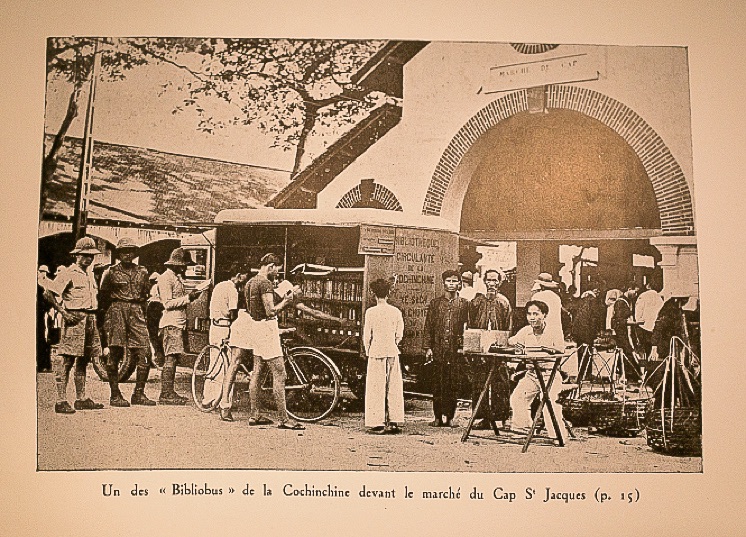
This talk examines the role of state-sponsored libraries within the landscape of print culture and reading public in late colonial Vietnam. I consider how library administrators and government officials defined ‘good reading’ as didactic, politically safe, and vulgarizing reading matter. Through the specific project of the Cochinchina Library bibliobus or xe sách [book wagon],* I reveal how colonial print control and book distribution drew inspiration from the Dutch East Indies Balai Pustaka and American libraries and publishing initiatives. This talk contributes two major interventions in the history of libraries and colonialism in Vietnam. Firstly, it situates the library within the landscape of print culture and peripheries of colonial control, and secondly it points to the administrative exchanges between imperial projects and international library sciences. This talk is part of my book manuscript Misreading: Social Life of Libraries and Colonial Control in Vietnam, 1865-1958. I examine the mechanics, discourse, and everyday practice of the library to fulfill its role as an official governmental institution, resource of public education, and cultural space for the practice of collective responsibility, urban civility, and public reading. I embed libraries within the multilayered landscape of print control—the politics of production, dissemination, and preservation of print matter. I follow the dynamic debates on print control among French colonial and post-colonial government administrators, librarians, archivists, translators, publishers, and readers. These diverse actors investigated the content, language, and influence of ‘good reading’ and initiated projects to disseminate reading matter through translation, publishing, and libraries.


 Cindy A. Nguyen